Company · 06.1
Inside the
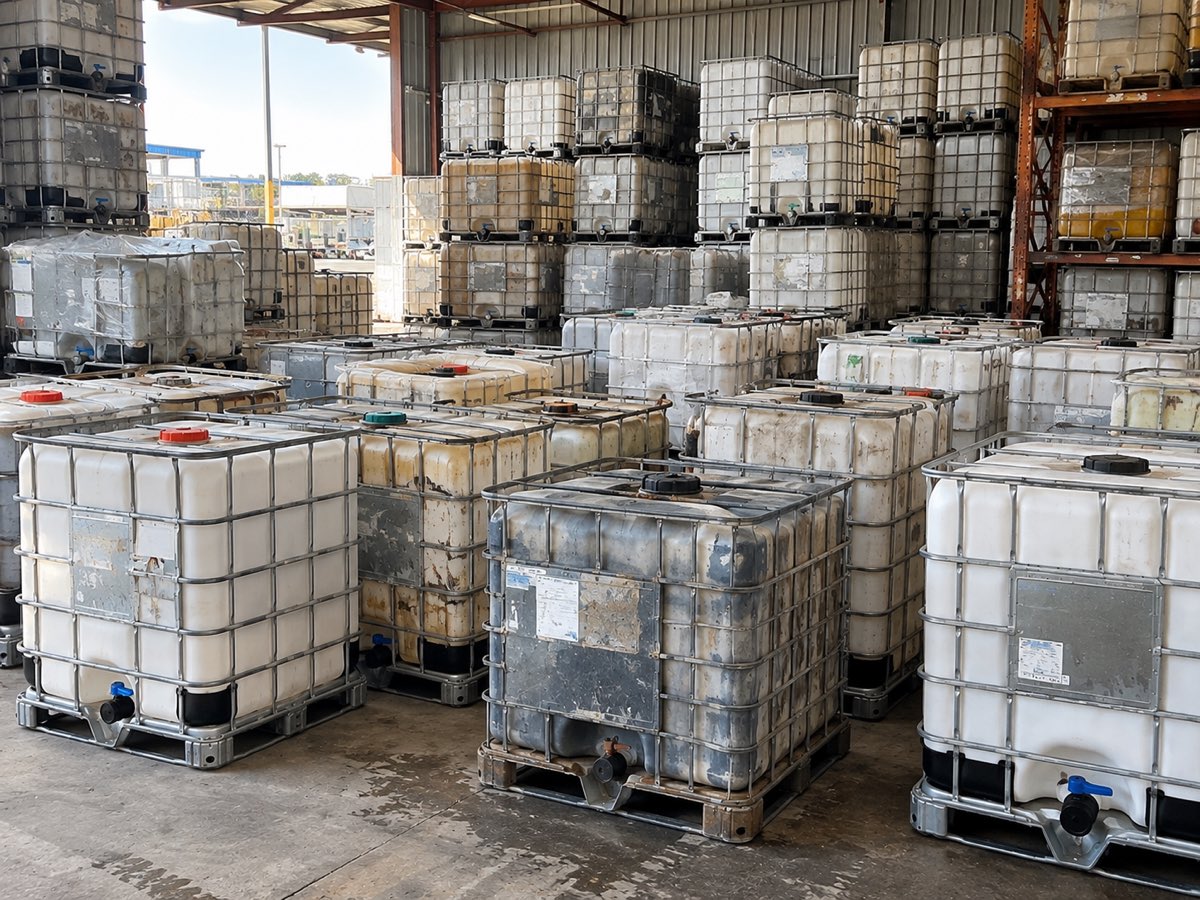
Savannah yard.
Short answer
- Visitors welcome during open hours — no appointment needed to look
- Food line physically separated from caustic and solvent
- UN re-marking performed on site under our own code
- Saturday mornings are pickup-only; the lines are down
Arrange a visit
The route a tote takes
Eight stations, in order
If you visit, this is the order we will walk you in — the same order a container travels. It takes about forty minutes.
- 01
Scale house and intake
Certified truck scale at the gate. Every inbound load is weighed, counted and assigned an intake reference before anything comes off the trailer. Prior-contents paperwork is checked here, not later.
- 02
Triage apron
Open concrete where loads are broken down and every unit is assessed: resale, reconditioning, rebottling or recovery. About 73% goes to one of the first three. Units with unidentifiable residue are tagged and segregated immediately.
- 03
Residue management
Heels drained, measured and manifested. Hazmat heels go to permitted disposal with documentation; everything else goes to the interceptor and treatment step. This is the least photogenic and most regulated part of the yard.
- 04
Wash bays — three lines
Caustic at 70 – 80 °C, hot water at 82 °C, and a solvent extraction line. The food line is a separate bay with its own lances, drain and staff rotation, and nothing that has carried caustic or solvent is ever used on it.
- 05
Rinse and camera inspection
Triple rinse with conductivity checked on the final flush, then a camera down the 6-inch lid looking for residue rings, haze, crazing and stress cracks at the bottom radius.
- 06
Cage shop
Hydraulic press for bowed uprights, dye-penetrant weld checks, shot-blast cabinet, and the base bench where steel, plastic, composite and wood bases are repaired or swapped.
- 07
Test bay
Leakproofness at 3 psi minimum with gauge traces retained, hydrostatic to plate rating for five-year periodics, and the marking station where we re-mark under our own reconditioner code.
- 08
Grading floor and recovery
Final grade assigned, labelled and staged by grade for outbound. Alongside it, the granulator and baler handle the 6% that did not make it, with certified scale tickets per stream.
Plant list
What is actually installed
Published because people ask, and because a supplier who will not tell you what equipment they run probably does not run it.
| Station | Equipment | Capacity | Notes |
|---|---|---|---|
| Gate | Certified truck scale | 80,000 lb | Every inbound and outbound load weighed |
| Wash bay 1 | Caustic line, rotating lance | ~34 units/shift | 2 – 4% NaOH, 70 – 80 °C, liquor recovered and re-titrated |
| Wash bay 2 | Hot-water line (food) | ~28 units/shift | Physically separated. Potable water at 82 °C, no chemistry |
| Wash bay 3 | Solvent extraction line | ~16 units/shift | Closed loop with solvent recovery. Never used on food units |
| Rinse | Triple-rinse station, conductivity meter | In-line | Final rinse conductivity logged against the serial |
| Inspection | Borescope camera rig | In-line | Interior imaging through the 6-inch lid |
| Cage shop | 30-ton hydraulic press, shot-blast cabinet | ~40 cages/shift | Dye-penetrant weld inspection |
| Test bay | Leakproofness rig + hydrostatic bench | ~50 units/shift | Gauge traces retained per serial |
| Marking | Plate press and die set | In-line | Under our own reconditioner registration code |
| Rebottling | Bottle seating jig and strapping bench | ~22 units/shift | Food and industrial resin bottles stocked |
| Recovery | Granulator + horizontal baler | ~6 t/day combined | Regrind sorted by colour and melt index |
| Effluent | Interceptor and treatment skid | Permitted discharge | About a third of our wash-stage energy |
If you visit
Gate rules, in the order they matter
We genuinely like visitors. We like visitors who have read this paragraph considerably more.
Report to the scale house first
On your left as you come through the gate. Nobody should be wandering a working yard without someone knowing they are there.
Closed-toe shoes and eyes up
High-visibility vests are provided. There are forklifts and a hydraulic press, and both of them are louder than they look useful.
Trailers back along the north fence
Pull in, swing left, reverse along the fence line. The apron in front of the wash bays stays clear during shift hours.
Self-collection: bring straps
We will load you, we will not strap your load. Totes shift, and an unstrapped 275 that goes over on Abercorn Street is somebody else's afternoon as well as yours.
Saturdays are pickup-only
9 AM to 1 PM. The wash line and test bay are down, so there is nothing to see — but your order will be staged and ready.
Finding us
10305 Abercorn StSavannah, GA 31406
Southside Savannah on Abercorn, inside the I-95 / I-16 corridor and about twenty minutes from the Port of Savannah — which is why the yard is here rather than somewhere cheaper.
- Monday – Thursday
- 7:30 AM – 5:00 PM ET
- Friday
- 7:30 AM – 3:30 PM ET
- Saturday
- 9:00 AM – 1:00 PM ET (yard pickups only)
- Sunday
- Closed
What the yard tells you
Four things worth looking at if you come
If you are evaluating a container supplier, these four observations will tell you more than any specification sheet.
Is the food line actually separate?
Walk to it. If the food wash shares lances, drains or staff rotation with a caustic line, the food-grade claim is unsupportable. Ours is a separate bay and we will show you the drain.
Is there a test bay at all?
Plenty of yards selling "reconditioned" totes have a pressure washer and no test rig. The 3 psi leakproofness test is the dividing line between reconditioned and rinsed, and you can see whether it exists in about four seconds.
Where does the scrap go?
Ask to see the granulator and the baler. If recovery is subcontracted, nobody in the building can tell you where the plastic went — which makes a zero-landfill claim untestable.
Is the grading honest?
Look at the staged outbound stock by grade. If the as-is pile and the reconditioned pile look identical, one of those labels is doing no work.
Related
Washing & Reconditioning
What happens in the wash bays, in detail.
UN/DOT Certification
Inside the test bay and the marking station.
Recycling & Resin Recovery
The granulator and baler at the back of the yard.
Savannah, GA Hub
Directions, lanes and transit expectations.
Our Story
How one rented wash bay became all of this.
Careers
Who works here, and what the roles involve.
Throughput
What the site processes in a normal week
Published so that anyone scoping a toll-wash programme or a large order can see whether it fits.
| Station | Weekly capacity | Typical utilisation | Constraint |
|---|---|---|---|
| Intake and triage | ~1,100 units | 70 – 85% | Yard space, not labour |
| Caustic wash | ~170 units | 75 – 90% | Cycle time and effluent treatment |
| Hot-water wash (food, segregated) | ~140 units | 45 – 70% | Affidavit-backed intake, not capacity |
| Solvent line | ~80 units | 40 – 60% | Intake volume |
| Cage shop | ~200 cages | 60 – 80% | Press jig availability |
| Test bay | ~250 units | 50 – 75% | Rarely the bottleneck since 2023 |
| 48-hour odour hold | Floor-space limited | ~90% | The real constraint on throughput |
| Rebottling bench | ~110 units | 55 – 75% | Bottle stock in the right resin |
| Granulator | ~18 t | 50 – 70% | Disassembly labour ahead of it |
| Baler | ~12 t | 45 – 65% | Mill collection schedule |
The hold is the binding constraint and it is floor space rather than equipment. We could wash more units a week than we can hold for 48 hours afterwards, and since we will not skip the hold, that sets the ceiling.
Compliance
Permits, controls and what gets inspected
A reconditioning yard is a regulated operation. This is what governs ours, in plain terms.
| Area | What applies | How it is evidenced |
|---|---|---|
| Effluent discharge | Permitted discharge with pre-treatment | Interceptor, sampling records |
| Hazmat residue handling | Manifested transfer to permitted disposal | Manifests retained per consignment |
| UN packaging reconditioning | Registered reconditioner, own code since 2023 | Quality programme, calibrated test equipment, audit |
| Test equipment | Calibrated at defined intervals | Traceable calibration certificates |
| Marking control | Dies held under key by the test technician | Marking cannot precede a pass |
| Records retention | Life of the container plus two years | Indexed by serial |
| Food line segregation | Physical separation: bay, lances, drain, staff rotation | Audited internally and by customers |
| Partner yard standard | Unannounced annual audit against our standard | Audit reports; two decertifications since 2021 |
Short answer
- Customer audits are welcome and reasonably common
- Marking dies are locked and held by the test technician
- Records are indexed by serial, not by order
- The food line has its own drain, not a shared one
From the Yard Journal
Longer pieces from the people who run the wash line, the test bay and the trading desk.
18 December 2025 · 4 min
Our grading floor is deliberately boring
Six labelled bays, one decision per unit, no judgement calls allowed at the end of a shift. Interesting processes produce inconsistent grades.
Priya Raghunathan · Head of reconditioning
Read26 October 2023 · 5 min
Our first failed partner yard audit
We decertified a yard in 2021. They were not cutting corners on purpose — they were running one wash chemistry, and that is enough.
Marcus Vreeland · Founder
Read2 September 2022 · 6 min
Why your tote still smells after we washed it
Permeation is not a cleaning failure. It is a material property of HDPE, and understanding it explains most of the grading rules in this industry.
Priya Raghunathan · Head of reconditioning
Read
Next move
Walk in during open hours. No appointment needed.
10305 Abercorn St, Savannah, GA 31406. Report to the scale house, bring closed-toe shoes, and allow forty minutes. We would much rather you saw the wash line than took our word for it.