Sustainability · 04
Recycling is the
consolation prize.
Reuse is the win.
Short answer
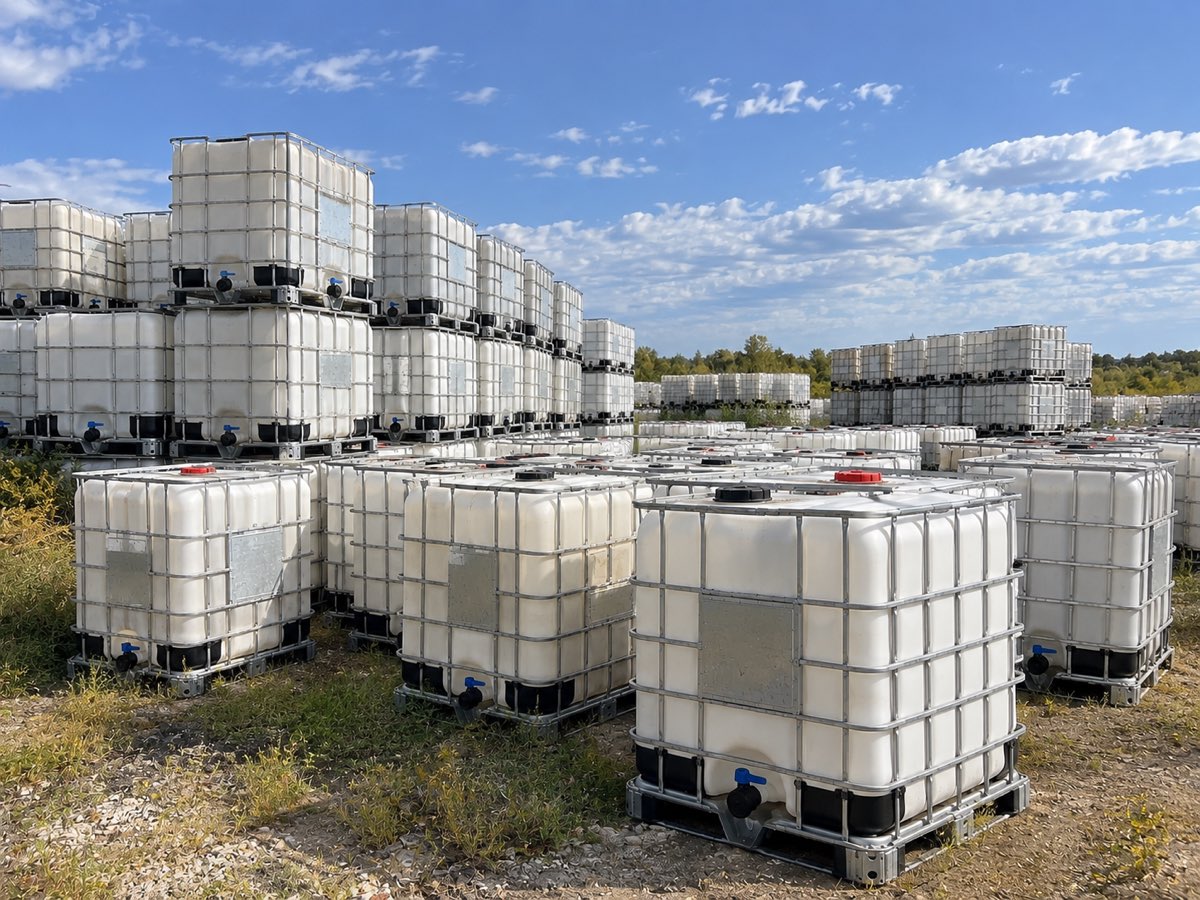
- 1.48 million totes diverted from landfill since 2009
- 41,200 tons of HDPE and 24,600 tons of steel kept in service
- Zero units landfilled since 2017 — verifiable against weigh tickets
- Every coefficient published, including the unflattering ones
Ask about our impact data
Cumulative, since 2009
What seventeen years of refusing to buy new adds up to
These are our own figures, derived from unit counts and weigh tickets rather than modelled from industry averages. The methodology is published in full, and we would rather you checked it than believed it.
- 1.5M
- Totes diverted from landfill
- 41,200
- Tons of HDPE kept in service
- 24,600
- Tons of galvanised steel reused
- 186,000
- Tons CO₂e avoided
Resold, reconditioned, rebottled or recovered
Reused as bottles plus recovered as regrind
Cages and pallet bases straightened and returned
Against new-container equivalents being made instead
- 92M
- Gallons of process water avoided
- 7
- Average turns per bottle
- 0
- Units sent to landfill since 2017
Resin polymerisation and steel production
Before granulation — the number that matters most
Every unit has a documented disposition
The hierarchy, honestly applied
Four tiers, and most companies market the third one
The waste hierarchy is not controversial. What is unusual is operating a business where every tier is in-house, so there is no point in the chain where we hand a problem to someone whose incentives differ from ours.
01
Reuse as a container
Wash it, test it, send it round again. Avoids the entire manufacturing burden of a replacement: 126 kg CO₂e per unit. This is where we put 73% of inbound volume.
02
Repair, then reuse
Rebottle the cage, straighten the frame, swap the base. Keeps 44 kg of galvanised steel out of a furnace even when the plastic is finished.
03
Reuse as an object
Cut it into a trough, a planter wall or a rack. Skips the furnace entirely and gives the material another decade of physical service.
04
Recover the material
Granulate the HDPE, bale the steel. Recovers the molecules but still pays the re-melting energy. Necessary, useful, and never the goal.
There is no fifth tier. Since 2017, no tote entering our gate has had a path that ends in a landfill, and we will show you the weigh tickets that prove it. Diversion reporting →
Calculate your own
The Reclaim Meter
Set a grade and a quantity. It computes the manufacturing burden your order avoids versus the same containers being made new, then converts it into miles not driven and trees' worth of annual sequestration.
The Reclaim Meter
Live · published coefficients
We spend about 88 kg CO₂e washing, testing and hauling each unit. It is still a 126 kg net win.
- CO₂e avoided
- 3.02 t
- Material kept in service
- 2,304 kg
- Landfill volume avoided
- 8.2 m³
- Process water avoided
- 7,440 gal
- Equivalent to not driving
- 7,754 mi
- Or a year's work by
- 138.7 trees
vs. 24 new composite IBCs
1,248 kg HDPE · 1,056 kg steel
Crushed-unit basis
Resin + steel production
At 0.39 kg CO₂e per mile
At 21.8 kg CO₂e sequestered per tree-year
Reclaim gauge
3t
CO₂e you do not emit by refusing a new tote
Every coefficient in this tool is listed with its source on the carbon math page. Nothing is rounded up for effect.
Why the turn count is everything
7.4 turns is the whole business model
A container used once and recycled recovers its material. A container used 7.4 times before recycling does that too — and avoids 6.4 manufacturing events on the way.
| Scenario | Containers made | CO₂e per fill cycle |
|---|---|---|
| Single-use, then recycled | 1 per fill | ~214 kg |
| Reused 3 times, then recycled | 1 per 3 fills | ~100 kg |
| Our pool average: 7.4 turns | 1 per 7.4 fills | ~41 kg |
| Rebottled once, then 7.4 more turns | 1 bottle per ~15 fills | ~27 kg |
This is why we buy totes with cracked bottles, why we hold our own UN reconditioner code, and why our traders are measured on used-first sourcing rather than margin per unit. Everything in the operating model exists to push that turn number up.
Operational commitments
Six things we actually do, not six things we aspire to
Every one of these costs us money. That is roughly how you tell a commitment from a marketing line.
Used-first sourcing policy
Traders must exhaust reclaimed stock across our yard and all 38 partner yards before quoting a new container. We lose margin points on this and keep the policy anyway.
Reusable dunnage, never film
Corner board and straps return on the next inbound run. It costs more per load and means your dock does not inherit a bale of stretch-wrap every delivery.
Partner yards instead of depots
We certify independent yards to our wash and grading standard rather than building our own. Freight miles per tote are down 41% against our 2019 baseline.
Wash water treated and recycled
Caustic liquor is recovered and reused across cycles until titration drops below spec. Effluent goes through an on-site interceptor under permit.
We buy what others reject
Cracked bottles, weathered units, bare cages. Those are rebottling and recovery candidates, and refusing them is how material ends up in a landfill somewhere else.
Published methodology
Every coefficient, source and assumption is on the carbon math page, including the 88 kg per unit that reconditioning costs us. Numbers you cannot check are marketing.
Where we are not clean
The parts of this that are not green
A used-container business still runs trucks, heats water and buys caustic. Pretending otherwise would undermine the figures that are genuinely good.
Freight is our largest single impact
Reconditioning costs about 88 kg CO₂e per unit, and roughly 38 kg of that is inbound and outbound haulage. Moving a used tote 900 miles to avoid making a new one is still a net win, but it is a thinner win than moving it 90 miles. That is the entire reason we certified partner yards instead of centralising volume in Savannah.
Caustic is caustic
Our wash lines use sodium hydroxide, heated water and electricity. We recover and re-titrate the liquor across cycles and treat the effluent under permit, but the honest framing is less bad than manufacturing, not harmless.
New bottles are new plastic
Rebottling consumes 52 kg of virgin HDPE per unit. Its 64 kg CO₂e saving is real but it is half of what reconditioning achieves. When a customer could use reconditioned and chooses rebottled for cosmetic reasons, that is a worse outcome and we say so during the quote.
Some totes genuinely cannot be saved
About 6% of intake fails resale grading. Permeated walls, crazing, unidentifiable residue. We recover the material, which is the right answer, and it is still the fourth-best tier of the hierarchy.
Our own footprint, published
| Source | Share of our emissions |
|---|---|
| Inbound and outbound freight | 43% |
| Wash water heating | 21% |
| Yard electricity | 14% |
| Granulation and baling | 11% |
| Caustic and chemistry | 7% |
| Buildings and other | 4% |
Short answer
Go deeper
Four pages of detail
Questions
Sustainability questions
Is reusing a tote really better than recycling it?
By a wide margin. Reuse avoids the full manufacturing burden of a replacement container — roughly 115 lb of virgin HDPE, 60 lb of galvanised steel and the energy to mould and weld them. Recycling recovers the material but still pays the re-moulding energy. Our carbon math page shows every coefficient.
How much CO₂ does buying used actually save?
About 126 kg CO₂e per 275-gallon composite tote against a new equivalent, dominated by avoided virgin HDPE (roughly 1.9 kg CO₂e per kg of resin) and avoided galvanised steel. The Reclaim Meter calculates it for your order quantity.
Can I get documentation for our ESG report?
Yes. Our diversion reporting service issues audit-ready certificates with unit counts, tonnage by material stream, methodology and coefficient sources — not a marketing badge.
What happens to a tote you cannot resell?
Bottle granulated into regrind, cage sheared and baled to mill spec, pallet reused or scrapped by material. Since 2017 no tote entering our gate has had a path that ends in a landfill.
Comparisons
Where a reclaimed tote sits against the alternatives
Bulk liquid has four realistic packaging routes. This is the honest comparison, including where reuse loses.
| Route | Containers made | Approx. CO₂e per 275 gal | Notes |
|---|---|---|---|
| New composite IBC, single use | 1 per fill | ~214 kg | The baseline we measure against |
| New steel drums (5), single use | 5 per fill | ~140 kg | Lighter per unit; worse on labour and spill frequency |
| Reconditioned drums, 5 turns | 1 drum-set per 5 fills | ~36 kg | Genuinely competitive with totes |
| Reconditioned IBC, 7.4 turns | 1 per 7.4 fills | ~41 kg | Our pool average |
| Pooled reclaimed IBC, 9 turns/yr | — | ~29 kg | Best available with current equipment |
| Rebottled IBC, 7.4 turns | 1 bottle per 7.4 fills | ~55 kg | New resin each bottle generation |
Note row three. Reconditioned drums and reconditioned totes are close, and on a single-use basis drums are actually better because a steel drum is a lighter object. The tote wins on labour, floor space, spill frequency and freight — not on a decisive carbon margin. Anyone claiming otherwise has not run the comparison.
For your reporting
How to use our figures without over-claiming
Avoided emissions are genuinely useful and they are also the easiest number in sustainability reporting to misuse. This is how to present ours so it survives review.
| Do | Do not | Why |
|---|---|---|
| Report it as a separate avoided-impact disclosure | Net it against a Scope 3 figure | Avoided emissions are not a scope; netting invalidates both |
| State the uncertainty band (±15%) | Quote to three significant figures | The coefficients are industry averages, not measurements |
| Cite the methodology page | Cite only the headline number | A reviewer will ask where it came from |
| Use observed cycles | Project continued performance for lost units | This is the largest source of overstatement in reuse reporting |
| Describe it as first-party | Describe it as verified or assured | It is not third-party assured and we say so |
| Include the disposal line | Omit the units that went to permitted disposal | Its presence is what makes the rest credible |
Short answer
- Avoided impact sits outside the Scope 1/2/3 inventory
- Our certificates are formatted so that mistake is hard to make
- Every tonnage line traces to a certified scale ticket
- Historical certificates are available back to 2019
From the Yard Journal
Longer pieces from the people who run the wash line, the test bay and the trading desk.
13 February 2025 · 3 min
Why we publish the 88 kg we spend
Most avoided-emissions figures count only the avoided side. Ours subtracts what reconditioning actually costs us, and that subtraction is the reason the number is usable.
Theo Marsh · Materials & reporting
Read9 January 2025 · 4 min
The tote that came back eleven times
Asset 4417 cycled through our wash line eleven times across four years and three owners. Here is its complete file, and what it says about the 7.4 average.
Priya Raghunathan · Head of reconditioning
Read5 September 2024 · 4 min
What regrind buyers actually pay for
Colour and melt index, in that order. Sorting to that granularity cut our granulator payback from 4.5 years to 3.2, and nobody modelled it in advance.
Theo Marsh · Materials & reporting
Read
Next move
Buy used. It really is that simple.
Every reclaimed tote you order is a new one that does not get made. If you want the number for your own order, the Reclaim Meter will calculate it — and we will put it on a signed certificate if your reporting needs one.