Services · S-01
Sell us
your totes.
Short answer
- Bid same business day on standard grades
- Scrap units paid by weight against prevailing markets
- Diversion certificate issued for your ESG reporting
- Whole-yard clear-outs handled as decommissioning
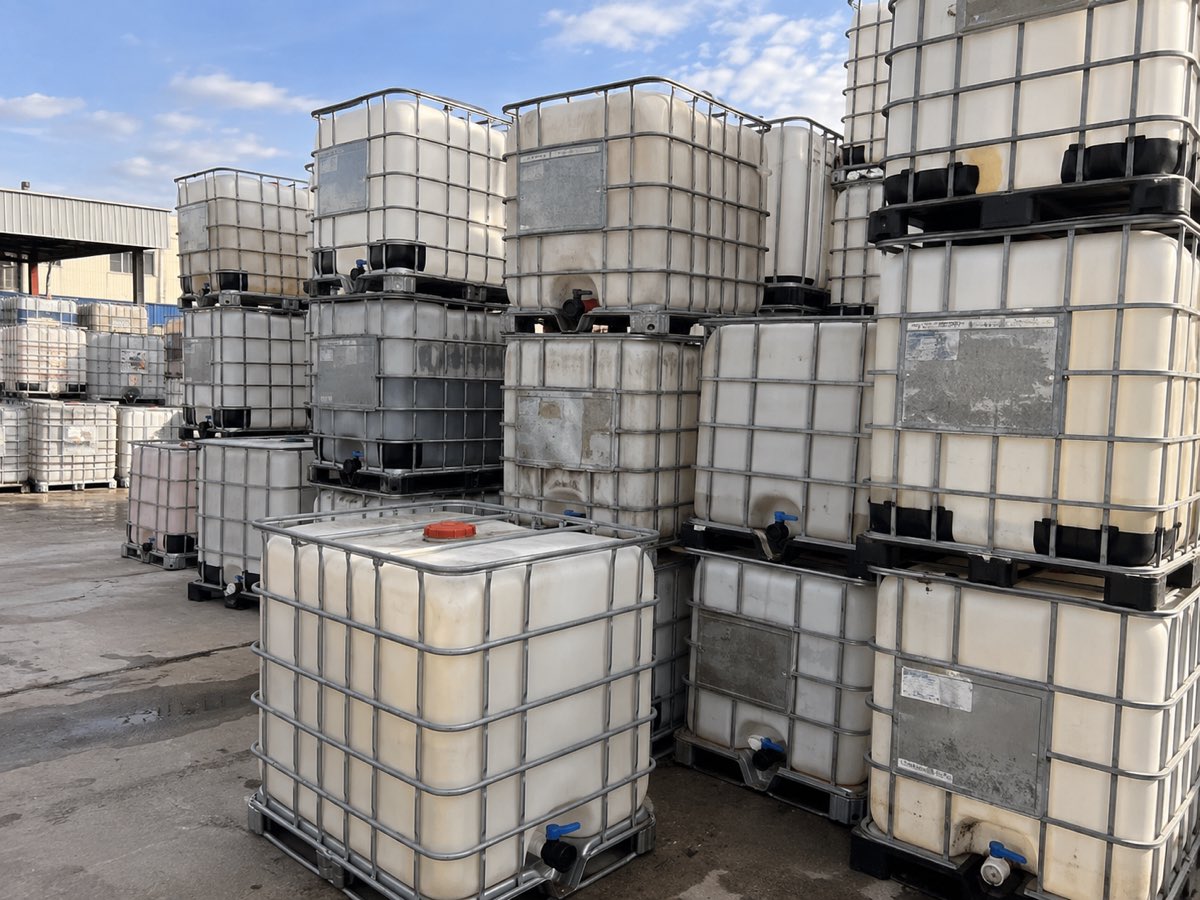
Tell us what you have
What it is worth
Indicative buy prices, 2026
These are what we pay, ex-your-dock, for a 275-gallon composite unit. Freight and volume move them; condition moves them more.
| Condition | Paid per unit | What we do with it | Notes |
|---|---|---|---|
| Food-grade, documented history | $65 – $120 | Hot-water line, resold as food grade | Affidavit from the original filler multiplies the value |
| Clean industrial, sound bottle | $38 – $72 | Reconditioned and resold | Our highest-volume intake |
| Sound cage, cracked or crazed bottle | $22 – $44 | Rebottled; old bottle granulated | Most dealers refuse these. We want them. |
| Unwashed, non-hazmat residue | $18 – $38 | Washed on matched chemistry, then graded | Prior contents must be identifiable |
| Structurally damaged, bottle intact | $12 – $26 | Bottle reused, cage baled | Bent is fine; kinked and cracked welds are not |
| Scrap, both components spent | By weight | Granulated and baled | ~115 lb HDPE + ~60 lb steel per unit |
| Bare cages | $14 – $30 | Straightened for rebottling | Sold on as bare cages or rebottled |
| Hazmat residue, with manifest | Quoted case by case | Reconditioned or recycled | Never resold unwashed, at any price |
Above 24 units in our active lanes we collect free, so the figure above is what lands with you. Below that, or well off-lane, we net the freight and show you both numbers rather than quietly burying one in the other.
The process
Four steps, and nobody phones you
- 01
Send the list
Unit count, prior contents, rough condition split and your zip code. Photographs help but are not needed for a first number — a count and a chemical name is enough to start.
- 02
We bid in writing
Same business day for standard grades. Hazmat residue needs a manifest before we quote, every time, with no exceptions and no hard feelings.
- 03
We schedule the haul
Free pickup above 24 units in our lanes. We bring reusable dunnage and a crew that has loaded totes before. Tell us about dock height, gate width and surface.
- 04
Paid on pickup, documented
Payment on collection by cheque or ACH, plus a diversion certificate stating units and tonnage by material stream — the document your sustainability team actually needs.
We want these
Including the ones others turn down
Cracked and crazed bottles
Sound cage plus dead bottle equals a rebottling candidate. This is the category other dealers decline and we actively seek.
Mixed-condition piles
Twenty good, forty questionable, ten obviously scrap. We triage on site and price each band separately.
Bare cages and loose bases
By the hundred if you have them. Rebottlers buy every cage we can straighten.
Food-grade units with paperwork
If you can get an affidavit from your filler, the unit is worth roughly double an undocumented one.
Totes that have been outdoors for years
UV-crazed plastic still granulates and the steel still bales. Nothing here is beyond use.
We cannot take these
Four hard limits
Unidentifiable residue
If nobody can say what was in it, we cannot wash it safely or disclose it honestly. Both are disqualifying.
Hazmat without a manifest
We will take it with documentation. We will not take it on an assurance, however confident.
Permeated solvent and fragrance totes
Some products migrate into the HDPE wall permanently. Those units are scrap value only, and we will say so.
Totes still holding product
Drained means drained. We are not a waste disposal contractor and are not permitted to be one.
What selling to us achieves
The number your sustainability team wants
Selling empties is usually framed as recovering a bit of cost. The larger figure is on the diversion certificate.
- 126 kg
- CO₂e avoided per unit resold
- 52 kg
- HDPE kept in service per unit
- 44 kg
- Galvanised steel per unit
- 0
- Units we landfill
Versus a new composite IBC being made instead
Reused as a bottle, or recovered as regrind
Cage and base, straightened and reused
Every unit has a path. Since 2017, no exceptions.
A 200-unit sale is roughly 25 tonnes of CO₂e avoided and 19 tonnes of material kept in service. We will put that on a signed certificate with the methodology attached — diversion reporting.
Questions
Selling questions
Will you buy my empty totes?
If they are drained, structurally intact and the prior contents are non-hazmat, almost always. Send quantity, prior contents, grade condition and your zip code and you will have a number back the same business day.
What makes a tote worthless to you?
A cracked or crazed bottle with a sound cage still has value — we rebottle it. What kills value entirely: unidentifiable residue, hazmat without a manifest, a bottle that held something that permeated the HDPE (certain solvents and fragrances), or a sheared pallet with a bent cage on the same unit.
Do you pay for scrap totes?
Yes, by weight. Roughly 115 lb of HDPE and 60 lb of galvanised steel per 275-gallon unit, priced against prevailing regrind and mill markets at the time of pickup.
Who pays the freight when I sell?
We do, above 24 units inside our active lanes. Below that, or well off-lane, we net the freight against the purchase price and show you both numbers.
Can you clear out a whole yard?
That is our decommissioning service. We triage on site — resell, recondition, recycle — haul everything, and issue one diversion certificate for the entire clear-out.
Getting a better number
Six things that move what we pay you
Bids on the same containers can differ by 40% depending on how they are presented. None of these require you to do work you were not going to do anyway.
| Factor | Effect on price | What to do |
|---|---|---|
| A prior-contents affidavit on food-grade units | +80 – 110% | Ten minutes of paperwork per batch, signed by your QA |
| Sorting by prior contents | +8 – 15% | Keep batches from one filler together |
| Keeping them out of the sun | +10 – 25% | Covered storage, or a tarp. UV crazing is the main ager |
| Draining properly | +5 – 10% | Heels cost us manifesting and treatment |
| Volume on one lane | +10 – 20% | Consolidate to 24+ units so collection is free |
| Flexible collection date | +3 – 8% | Lets us batch the run with other pickups |
| Lids and valves still fitted | +4 – 7% | Missing parts are replaced at our cost |
The first row is the one that surprises people. If you fill food product in totes, an affidavit signed by your quality manager roughly doubles what the empties are worth to the next buyer. It is the highest-return ten minutes available in this process.
The paperwork
What you receive when you sell to us
Selling empties is usually treated as a disposal transaction. It generates documents that a sustainability or finance team frequently needs and rarely knows exist.
| Document | What it states | Who uses it |
|---|---|---|
| Purchase confirmation | Units, grades, price, collection date | Finance, accounts receivable |
| Collection manifest | Serials or counts collected, signed at the gate | Site operations |
| Prior-contents record | What you told us was in them | Our grading, retained for traceability |
| Hazmat manifest, where applicable | Residue disposition under permit | EHS |
| Diversion certificate | Units and tonnage by material stream, with methodology | Sustainability and ESG reporting |
| Certified scale tickets | Weighed tonnage for the recycled portion | Audit evidence behind the certificate |
| Asset disposal note | Confirmation units left your site and when | Fixed-asset write-off |
Short answer
- 200 units sold is roughly 25 t CO₂e avoided
- Tonnage traces to certified scale tickets, not estimates
- The certificate names what went to disposal as well as what did not
- Historical certificates available back to 2019
From the Yard Journal
Longer pieces from the people who run the wash line, the test bay and the trading desk.
28 February 2023 · 6 min
Nine things that arrive in a decommissioning load
A yard clear-out is never a clean count of one thing. Here is the actual mix from our last eleven jobs, including the units nobody warned us about.
Marcus Vreeland · Founder
Read9 August 2023 · 5 min
Hurricane season changes how we stack
An empty tote is a 132 lb sail. Here is what fifteen Atlantic seasons taught a yard eleven miles from the Georgia coast.
Marcus Vreeland · Founder
Read21 May 2026 · 4 min
What a crushed cage tells you about the bottle inside
Counterintuitively, the worse the cage looks, the better the odds on the bottle. We pulled three years of intake records to check.
Priya Raghunathan · Head of reconditioning
Read
Next move
How many, what was in them, what zip code?
Three facts and you will have a written bid the same business day. Use the form on this page and pick 'Sell my used totes' under Select service.