Company · 06.3
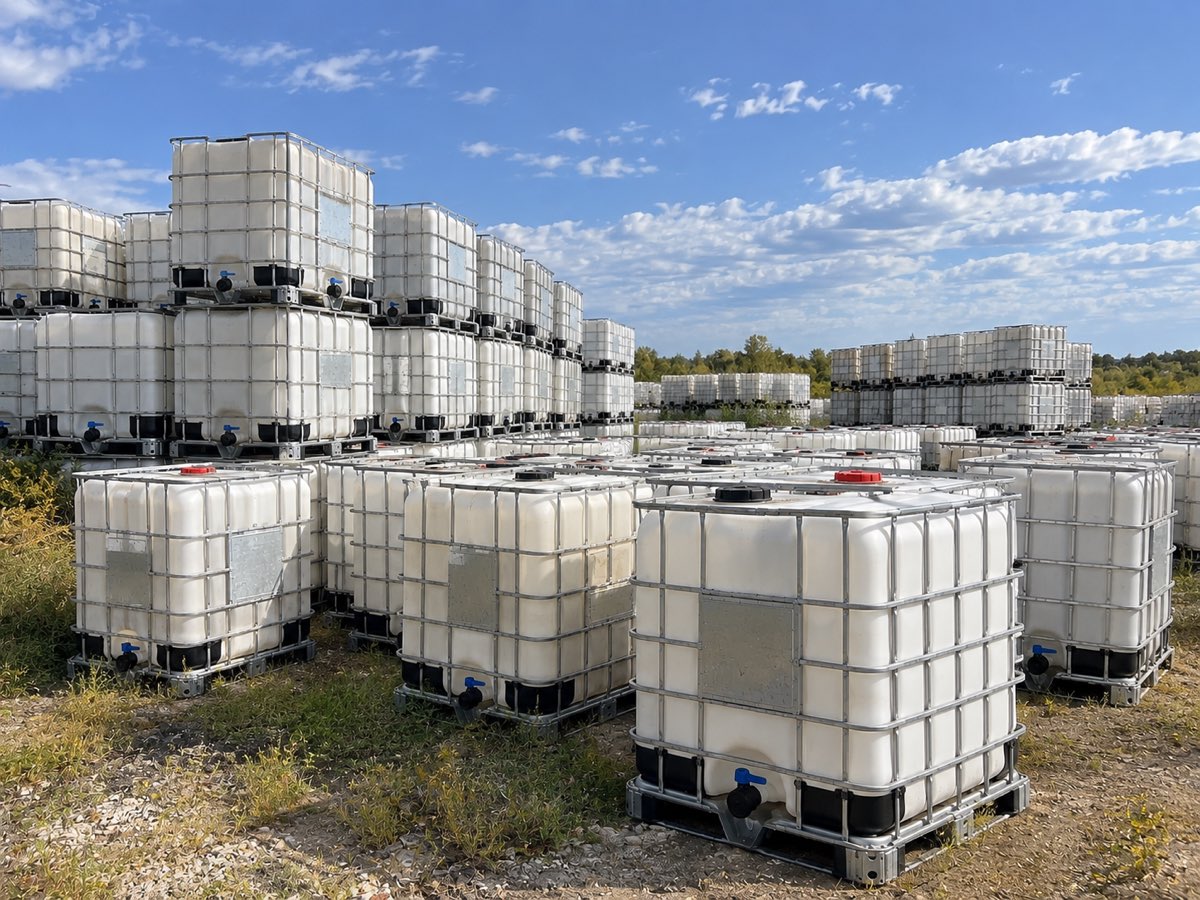
One yard.
Thirty-eight partners.
Short answer
- Head yard: 10305 Abercorn St, Savannah, GA 31406
- Partner yards audited to our wash and grading standard
- Freight miles per tote down 41% against our 2019 baseline
- Alaska and Hawaii: not served — the economics never work
Check coverage for your zip
By region
Where the stock actually is
Supply differs by region in ways worth knowing before you plan a project. Food-grade units are easiest to find in the Midwest; reconditioned chemical units are easiest on the Gulf.
| Region | States | Partner yards | Typical transit | What supply looks like |
|---|---|---|---|---|
| Southeast | GA, FL, SC, NC, AL, TN, MS | 11 yards | 1 – 3 days | Our home region. Same-week delivery on stock grades is normal here. |
| Gulf & South Central | TX, LA, OK, AR | 7 yards | 2 – 4 days | Heavy chemical and oilfield volume. Strong reconditioned supply, thinner food-grade. |
| Midwest | IL, OH, IN, MI, WI, MN, IA, MO, KS, NE | 8 yards | 2 – 5 days | Best food-grade supply in the network, driven by the corn and dairy corridors. |
| Northeast & Mid-Atlantic | PA, NY, NJ, MD, VA, WV, NE states | 6 yards | 2 – 5 days | Dense destinations, tight docks. Lift-gate LTL is the common mode. |
| Mountain & Southwest | CO, UT, AZ, NM, NV, ID, MT, WY | 3 yards | 3 – 6 days | Long hauls. Full-trailer orders make far more sense than LTL here. |
| West Coast | CA, OR, WA | 3 yards | 3 – 6 days | Strong ag and beverage demand. Regional supply is tight, so plan lead time. |
Why partners, not depots
More depots would have been the obvious mistake
Building our own network would have added capacity we did not need and freight miles we could not justify.
In 2019 we modelled two expansion paths. The first was conventional: build or lease four regional depots, staff them, equip them, and move stock between them. The second was to find independent yards that already existed, audit their wash and grading practice against ours, certify the ones that passed, and trade through them.
The second path won on the only metric that mattered: average haul distance per tote. Depots concentrate inventory and then pay to distribute it. Partner yards put stock where the demand already is. Freight miles per tote fell 41% over the following five years, which shows up both in what customers pay and in our emissions.
The cost is control, and we manage it with an audit. A certified partner yard is inspected against our wash chemistry selection, rinse procedure, test practice and grading language. Yards that drift get re-audited; two have lost certification since 2021.
What certification requires
- Documented prior-contents capture on every intake
- At least two wash chemistries, selected by residue class
- Triple rinse with a verification step
- A functioning leakproofness test rig
- Our grading language, used as written
- A disposition record for every unit, including scrap
- Annual re-audit, unannounced
Short answer
Network
The numbers
- 38
- Certified partner yards
- 48
- States served
- 41%
- Reduction in freight miles per tote
- 2
- Yards decertified since 2021
Independent, annually re-audited
Lower 48 only
Against our 2019 baseline
Published because the number matters
Our own yard
10305 Abercorn StSavannah, GA 31406
Southside Savannah, twenty minutes from the Port of Savannah, inside the I-95 / I-16 corridor. All rebottling, UN re-marking and material recovery happens here.
Savannah yard detailNot served
Alaska and Hawaii. Container freight to either destination costs multiples of the unit value, and we are not willing to quote a number that makes a used tote more expensive than a new one bought locally. If you are there, buy locally — that is also the better carbon answer.
We also do not ship internationally. Export wood-base requirements, customs and ocean freight make reclaimed containers uncompetitive almost everywhere.
Sourcing
Which yard your order actually ships from
We source from whichever certified yard holds the right grade closest to you. That is usually not Savannah, and it is why lead times vary by grade rather than only by distance.
| Grade | Usually sourced from | Why |
|---|---|---|
| Reconditioned industrial | Nearest certified yard to you | Available almost everywhere |
| Food grade, documented | Midwest corn and dairy corridors | That is where the affidavits are |
| Rinsed and as-is | Nearest yard | Commodity supply, freight-driven |
| Rebottled | Savannah | Rebottling bench and bottle stock are here |
| UN re-marked | Savannah | We hold the reconditioner code here |
| Stainless bins | Wherever a plant decommissioned | No pattern at all |
| Bare cages and bases | Nearest yard with a decommissioning job | Follows clear-out work |
| Fabricated and upcycled builds | Savannah | The fabrication bay is here |
This is why a reconditioned order to Denver can ship faster than a rebottled one, and why food grade from a Midwest yard sometimes reaches a Gulf customer sooner than stock we are holding locally. Send a postcode with the enquiry and we will tell you the real source and the real transit.
Partner standard
What a certified yard has to prove, every year
Published in full because a network is only as good as the weakest yard in it, and the audit is the only thing preventing that.
| Requirement | How it is checked | Fails if |
|---|---|---|
| Prior-contents capture at intake | Records sampled against physical stock | Units on the floor with no recorded history |
| Two or more wash chemistries | Walk the bays; ask what a resin tote goes through | One line and no diversion route |
| Triple rinse with verification | Observe a cycle; check the verification method | Visual check only |
| Functioning leakproofness rig | Observe a test; check calibration | No rig, or uncalibrated |
| 48-hour hold and odour check | Sample finished stock, not the line | Units graded same-day |
| Grading language used as written | Compare labels against our definitions | Local terms substituted |
| Disposition record for every unit | Trace a sample of scrap to a ticket | Scrap leaves without a record |
| Food line physically separate | Trace the drain and the lances | Shared equipment with caustic |
Short answer
- Audits are unannounced and annual
- Finished stock is sampled, not units mid-process
- Two yards have lost certification since 2021
- A yard that cannot run your residue class sends the units to us
From the Yard Journal
Longer pieces from the people who run the wash line, the test bay and the trading desk.
26 October 2023 · 5 min
Our first failed partner yard audit
We decertified a yard in 2021. They were not cutting corners on purpose — they were running one wash chemistry, and that is enough.
Marcus Vreeland · Founder
Read4 April 2024 · 4 min
The economics of a ten-unit order
Ten units is the most common order size we quote and the most frequently mispriced by the buyer. The lever is not the grade.
Nina Caldwell · Trading desk
Read5 March 2026 · 4 min
Tote pooling maths for a blender shipping to forty customers
A worked example with real numbers: when a managed pool beats owning containers, and the two conditions under which it does not.
Dale Ferreira · Logistics lead
Read
Next move
Send your zip code with the request.
Freight is usually the largest single variable in a used-tote price. With a zip we can tell you which yard your stock comes from, what it costs landed, and how long it takes.