Knowledge · G-06
Freight &
palletizing.
Short answer
- 15 filled 330s ≈ 43,500 lb — also a full load
- Two high filled is the practical maximum in transit
- Nesting vs non-nesting is ~17% of freight cost per unit
- Four site facts prevent nearly every reconsignment
Quote a load
The geometry
Two-wide, twenty-one deep
A 53-foot van has roughly 630 inches of usable length and 100 inches of usable width. A tote is 48 × 40. Everything about tote freight follows from those three numbers.
Plan view · 53-ft van · 21 positions × 2 wide · highlighted cells show a staggered strap pattern
| Equipment | Usable length | Nested empties | Non-nesting empties | Filled 275s | Filled 330s |
|---|---|---|---|---|---|
| 53-ft dry van | 630 in | 42 | 36 | 18 | 15 |
| 48-ft dry van | 570 in | 38 | 32 | 18 | 15 |
| 48-ft flatbed | 576 in | 40 (tarped) | 34 | 18 | 15 |
| 40-ft gooseneck / hotshot | 480 in | 24 | 20 | 14 | 12 |
| 28-ft pup trailer | 336 in | 20 | 18 | 9 | 8 |
| 26-ft box truck | 312 in | 14 | 12 | 8 | 7 |
| 20-ft container | 232 in | 14 | 12 | 8 | 7 |
| 40-ft container | 472 in | 30 | 24 | 18 | 15 |
Weight, not space
Why filled loads stop at eighteen
Legal payload on a standard five-axle tractor-trailer is around 44,000 – 45,000 lb depending on tractor weight. Totes hit that long before they fill the deck.
| Units | 275 gal @ SG 1.0 | 275 gal @ SG 1.2 | 330 gal @ SG 1.0 | 330 gal @ SG 1.2 |
|---|---|---|---|---|
| 12 | 29,124 lb | 34,632 lb | 34,824 lb | 41,436 lb |
| 15 | 36,405 lb | 43,290 lb | 43,530 lb | 51,795 lb ✗ |
| 16 | 38,832 lb | 46,176 lb ✗ | 46,432 lb ✗ | 55,248 lb ✗ |
| 18 | 43,686 lb | 51,948 lb ✗ | 52,236 lb ✗ | 62,154 lb ✗ |
| 20 | 48,540 lb ✗ | 57,720 lb ✗ | 58,040 lb ✗ | 69,060 lb ✗ |
✗ = exceeds a typical 44,000 lb legal payload. Confirm against your carrier’s actual tractor weight.
Short answer
- Water-density product: 18 × 275 gal or 15 × 330 gal
- At SG 1.2: 15 × 275 gal or 12 × 330 gal
- At SG 1.5 and above: 11 – 12 units maximum
- Always confirm the carrier tractor weight before loading
Securing the load
Five rules for strapping totes
- 01
Strap across, never along
Lateral straps across the width restrain the load against the trailer walls. Longitudinal straps do almost nothing on a tote because there is no structural member running fore and aft to pull against.
- 02
Corner board at every contact point
A ratchet strap tightened directly onto a cage rail crushes one tube and does nothing to the rest of the frame. Corner board spreads the load across several rails, which is the difference between restraint and damage.
- 03
Two straps per row, minimum
One strap pivots. Two restrain. On a three-high stack use three, with the top strap tensioned last so you are not pulling the stack over while you work.
- 04
Block the back of the load
A load bar or a final strap behind the last row. Under hard braking an unblocked load walks forward, and 44,000 lb arriving at the bulkhead is a serious event.
- 05
Reusable dunnage over film
Corner board and straps come back on the next inbound run and get reused forty times. Stretch-wrapping 42 totes uses about 11 lb of film that becomes waste at the receiving dock the same afternoon.
The expensive mistake
Four site facts, asked at order time
A reconsignment — a truck that arrives and cannot unload — costs several hundred dollars plus a redelivery, and it is almost always caused by one of four facts nobody mentioned when the order was placed.
- Is there a dock, and what height? A dock-height van at a ground-level site needs a lift-gate, and lift-gates must be booked, not improvised.
- Is there a forklift, and is it available that day? “We have a forklift” and “the forklift operator is on site Thursday” are different answers.
- Can a 53-foot trailer turn in? Gate width, turning radius, overhead wires and tree limbs. Check it with the driver’s eye, not the delivery address.
- What is the surface? A lift-gate onto gravel drops pallets. A pallet jack on dirt does not move. Say “gravel” if it is gravel.
Tell us all four in the message field with your order and the problem disappears. It is the cheapest four sentences you will write all week.
Freight cost, roughly
| Mode | Typical cost per unit |
|---|---|
| Yard collection | $0 |
| Local delivery under 50 mi | $12 – $24 |
| LTL, 1 – 4 units, 500 mi | $55 – $95 |
| LTL with lift-gate | +$45 – $85 per shipment |
| LTL, 8 units, 500 mi | $34 – $52 |
| Full trailer, 42 units, 500 mi | $14 – $22 |
| Full trailer, 42 units, 1,200 mi | $28 – $42 |
This is why quantity changes the economics more than grade does. Going from 4 units to 42 drops freight per unit by roughly two thirds.
Questions
Freight questions
How many IBC totes fit in a 53-foot trailer?
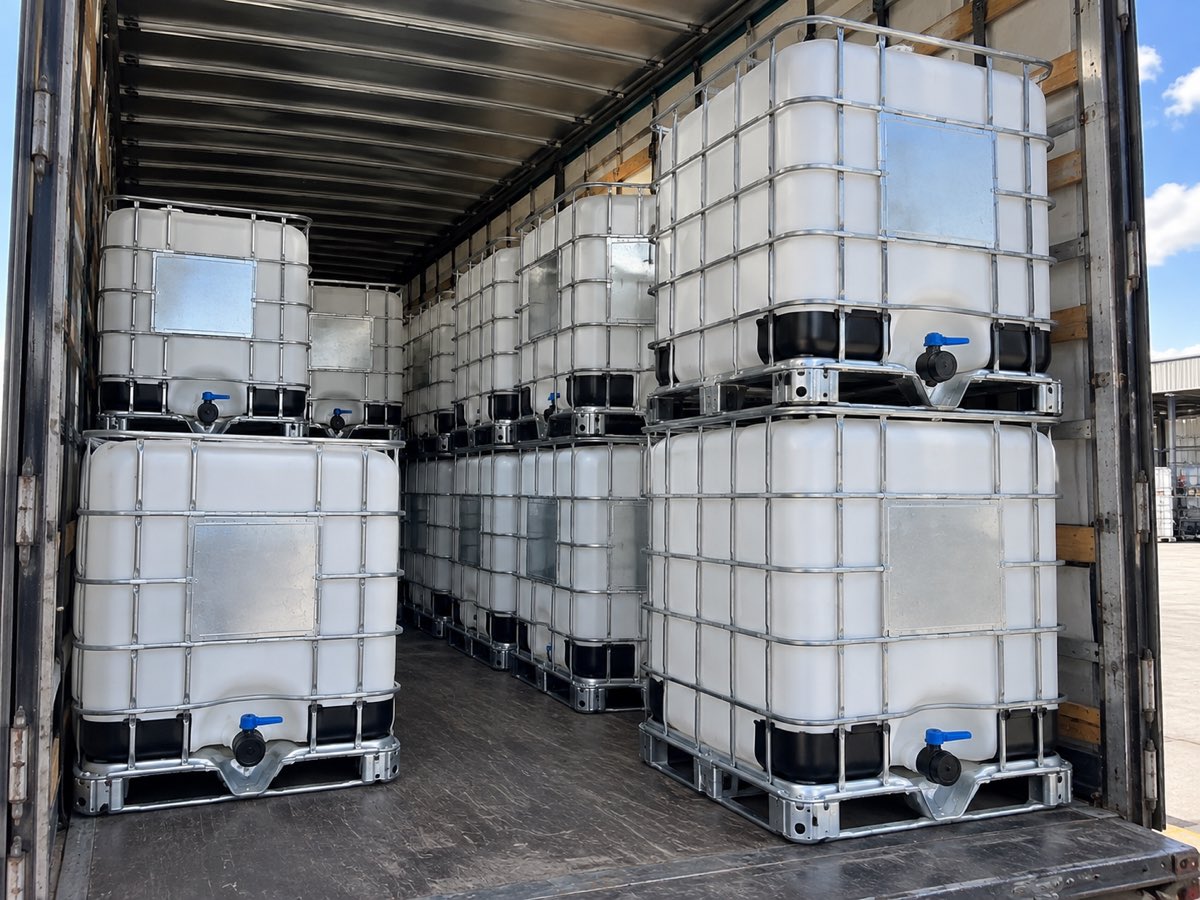
Empty and nesting: 42, loaded two-wide across 21 positions, three high. Non-nesting cages drop that to 36. Filled, weight is the limit long before space: 18 filled 275-gallon totes of water-density product is about 44,000 lb, which is a legal full load.
Why does nesting matter so much?
Nesting cages sit partly inside each other when empty, so three stack in the height of about 2.4 units. Non-nesting cages stack one-for-one. The difference between 42 and 36 units per trailer is roughly 17% of your freight cost per unit, which on a long haul is worth asking about.
How should totes be strapped?
Across the load, not along it, with corner board at every strap contact point to spread the load across the cage rails rather than crushing one tube. Two straps per row minimum, and a load bar or strap behind the last row so nothing walks forward under braking.
Can I load filled totes three high?
In a trailer, no — weight stops you long before height does. Three filled 275s is 7,300 lb on one 13.3 sq ft footprint, which concentrates load badly on a trailer floor and exceeds most stacking ratings in motion. Two high filled is the practical maximum in transit.
What causes most freight problems?
Site constraints not communicated at order time. No dock when the truck is a dock-height van, no forklift when the load is palletised, a gate too narrow for a 53-foot trailer to turn into. A reconsignment costs more than the grade upgrade most people are agonising over.
Freight classification
How IBC shipments get classified and why it moves the price
LTL pricing runs on density and class. Empty totes are bulky and light, which puts them in an expensive band — and understanding that explains most of the quote.
| Shipment | Weight | Cube | Density | Effect on LTL cost |
|---|---|---|---|---|
| 1 empty 275 gal tote | 132 lb | 36.8 ft³ | 3.6 lb/ft³ | Very low density — expensive class |
| 4 empty totes | 528 lb | 147 ft³ | 3.6 lb/ft³ | Same class, better per-unit rate |
| 1 filled 275 gal tote (water) | 2,427 lb | 36.8 ft³ | 66 lb/ft³ | High density — cheap class, but heavy |
| Bare cages, 10 | 600 lb | ~62 ft³ nested | 9.7 lb/ft³ | Better than complete units |
| Pallet bases, 20 | ~760 lb | ~28 ft³ | 27 lb/ft³ | Dense; cheapest to ship |
| Valves and fittings, boxed | ~40 lb | ~3 ft³ | 13 lb/ft³ | Parcel rather than LTL |
This is why empty totes ship badly on LTL and well on full trailers: you are paying for space rather than weight, and the only way to fix that is to fill the space. It is also why bare cages and components are disproportionately cheap to move.
Weight distribution
Loading a trailer so it passes a scale
A legal gross weight distributed wrongly is still an illegal load. For dense product in totes this is a real constraint rather than a theoretical one.
| Consideration | Figure | Why it matters |
|---|---|---|
| Typical legal payload, 5-axle | 44,000 – 45,000 lb | Set by tractor weight and bridge formula |
| Steer axle limit | 12,000 lb | Rarely the issue with totes |
| Drive axle limit | 34,000 lb | Loading too far forward |
| Trailer tandem limit | 34,000 lb | Loading too far rearward |
| Filled 275 gal, water | 2,427 lb each | 18 units reaches payload |
| Filled 275 gal, SG 1.4 | 3,574 lb each | 12 units reaches payload |
| Practical rule | Spread the load over the full deck | Do not block 12 heavy units at one end |
Short answer
- Dense product means fewer units spread over the same deck length
- Blocking heavy units at one end fails an axle check even at legal gross
- Send us the product density so we plan the load, not just the count
- Empty loads are space-limited; filled loads are weight-limited
From the Yard Journal
Longer pieces from the people who run the wash line, the test bay and the trading desk.
30 July 2024 · 4 min
The three questions that prevent a reconsignment
A truck that arrives and cannot unload costs several hundred dollars plus a redelivery. In four years, every single one traced back to the same three facts.
Dale Ferreira · Logistics lead
Read20 June 2023 · 5 min
Shrink wrap is a receiving-dock tax
Eleven pounds of film per trailer, cut off and binned the same afternoon. We switched to reusable corner board in 2019 and it cost us more. Here is the accounting.
Dale Ferreira · Logistics lead
Read4 April 2024 · 4 min
The economics of a ten-unit order
Ten units is the most common order size we quote and the most frequently mispriced by the buyer. The lever is not the grade.
Nina Caldwell · Trading desk
Read
Next move
Send origin, destination, quantity and the four site facts.
That is a firm freight number rather than a 'freight TBD' line. It is also frequently how we find you a quantity change that drops your landed cost by a fifth.