Totes & parts · 01
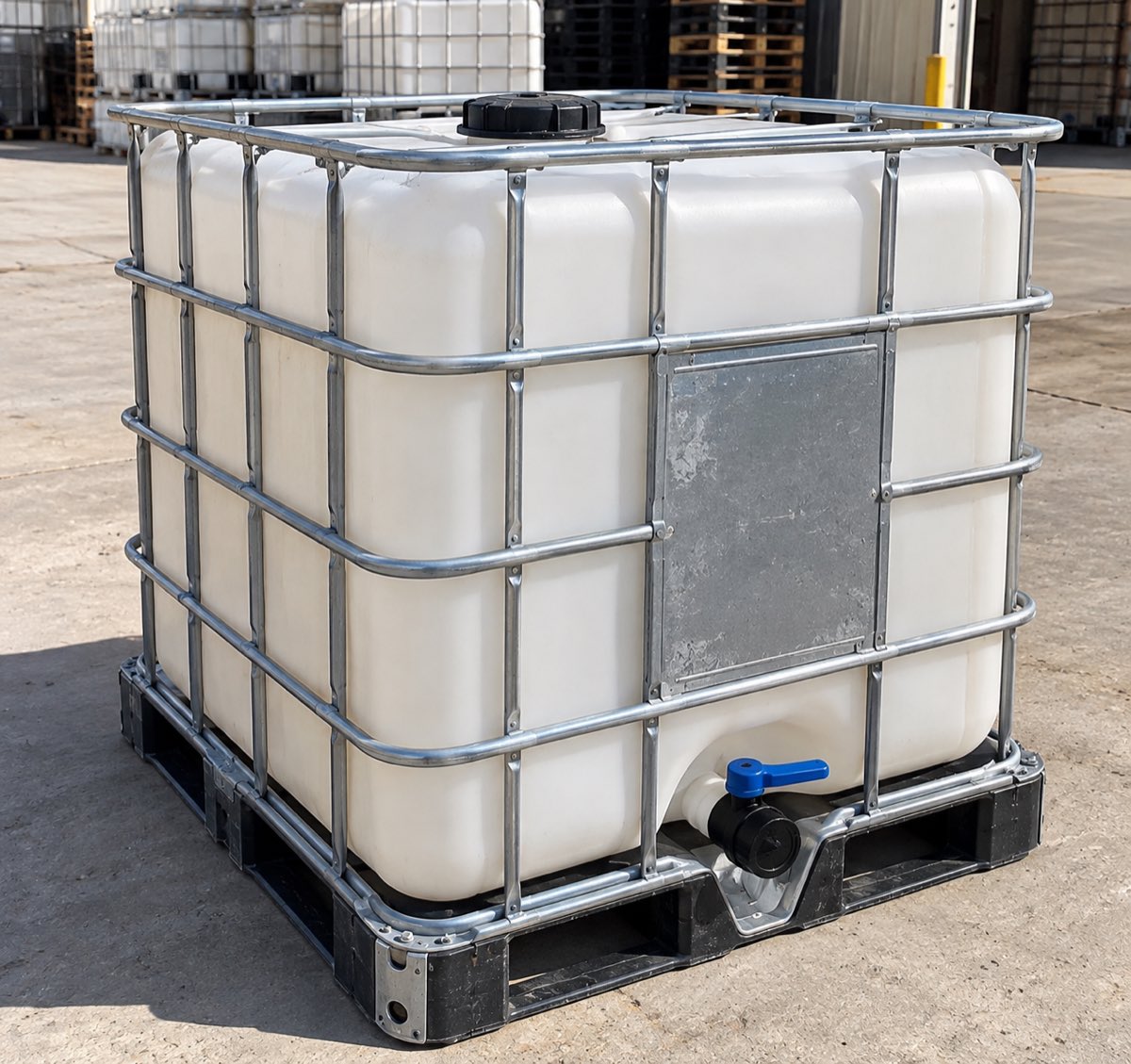
Whole totes.
And every part of one.
Short answer
- One-unit minimum for yard collection
- 120, 180, 275, 330 and 550 gallon sizes
- Steel, plastic and composite bases available
- Parts sold separately — cages, valves, lids, gaskets
Price a specific unit
The catalogue
Ten ways into our stock
Start with a size if you know the volume, a grade if you know the cleanliness requirement, or a component if you already own the container.
- P-01
275 Gallon IBC Totes
The 48×40×46 workhorse. Our highest-volume SKU.
Open - P-02
330 Gallon IBC Totes
Same footprint, seven inches taller, 20% more payload.
Open - P-03
Reconditioned Totes
Triple-washed, pressure-tested, re-certified cages.
Open - P-04
Rebottled Totes
New HDPE bottle, reclaimed cage and pallet.
Open - P-05
Food-Grade Totes
FDA 21 CFR 177.1520 bottles with documented prior contents.
Open - P-06
New IBC Totes
Factory-fresh UN31HA1 when the spec leaves no choice.
Open - P-07
Stainless Steel IBCs
304/316L bins for aggressive, hot or high-purity duty.
Open - P-08
Cages & Pallets
Bare galvanised cages, steel, plastic and composite bases.
Open - P-09
Valves, Lids & Fittings
Butterfly valves, camlocks, gaskets, caps, adapters.
Open - P-10
Upcycled Builds
Rain harvesters, planter walls, wash stations, dunnage.
Open
Sizes at a glance
Pick the footprint first, the capacity second
Nearly every tote in North America is built to the 48 × 40 inch GMA pallet footprint. Capacity varies by height, which means the constraint that bites you is almost always a door, a ceiling or a rack beam — not a floor.
| Capacity | Litres | Dimensions | Tare | Gross (water) | Base | Notes |
|---|---|---|---|---|---|---|
| 275 gal | 1,040 L | 48 × 40 × 46 in | 125 – 140 lb | ~2,440 lb (water) | Steel / plastic / composite | The default. Fits two-wide in a 53-ft trailer and clears a standard 7-ft dock door. |
| 330 gal | 1,250 L | 48 × 40 × 53 in | 140 – 158 lb | ~2,910 lb (water) | Steel / plastic | Same floor space, 20% more payload. Watch trailer height and 2-high storage racks. |
| 120 gal | 450 L | 40 × 48 × 28 in | 85 – 95 lb | ~1,090 lb (water) | Steel | Half-height. Popular for dense liquids where a 275 would exceed a floor or lift rating. |
| 180 gal | 680 L | 48 × 40 × 36 in | 105 – 118 lb | ~1,620 lb (water) | Steel / plastic | A compromise size, usually ex-adhesive or ex-resin service. Supply is thin. |
| 550 gal | 2,080 L | 48 × 48 × 72 in | 290 – 340 lb | ~4,900 lb (water) | Heavy steel | Non-standard footprint. Almost always rigid poly or stainless rather than composite. |
| 350 gal stainless | 1,325 L | 48 × 42 × 54 in | 420 – 520 lb | ~3,400 lb (water) | Integral legs | 304 or 316L bin with integral skirt. Rated for steam cleaning and CIP. |
Size finder
Working to real tare weights
Water = 1.00 · solvent ≈ 0.85 · 50% caustic ≈ 1.53
Closest fit
120 gal half-height
13 units · 1,091 lb each when filled · 173 sq ft of floor
See this size- 180 gal9 units · 1,614 lb filled
- 550 gal3 units · 4,900 lb filled
- 330 gal tall5 units · 2,902 lb filled
- 275 gal standard6 units · 2,427 lb filled
Grades
The same tote at six different prices
Grade is the biggest lever on what you pay. It describes what we did to the container and what we know about its history — not a promise that it suits your liquid.
- FG$185 – $340
Food Grade
Bottle moulded from virgin HDPE conforming to FDA 21 CFR 177.1520, with a documented chain of custody proving it has only ever held food-contact product.
- RC$120 – $225
Reconditioned
A used bottle that has been washed on a pressurised line, leak-tested, and reunited with a straightened, re-painted cage and sound pallet.
- RB$210 – $365
Rebottled
A brand-new HDPE bottle dropped into a reclaimed cage and pallet. You get virgin-bottle purity at roughly two-thirds the price of a new tote, and the steel still gets a second life.
- RN$95 – $165
Rinsed / Clean Used
Triple-rinsed at the filler or at our yard, visually clean, but not pressure-tested and not re-certified. The honest middle of the market.
- AI$55 – $110
As-Is / Unwashed
Sold exactly as it arrived, with residue disclosed. Cheapest route into a tote, and the right call if you are going to wash it yourself or cut it up.
- SCPaid by weight
Scrap / Recycle Only
End of the road for the bottle: cracked, crazed, UV-brittle or contaminated. The HDPE becomes regrind, the cage becomes baled steel, the pallet gets reused.
Choosing, in order
Four questions, in this sequence
- What goes in it? This decides grade and gasket compound before anything else. Potable or edible means food grade, full stop. Regulated liquid means a valid UN marking. Dust-control water means buy the cheapest sound unit you can find.
- How much, and how tall is the opening? Volume gives you unit count; door and ceiling height rule out the 330 and the 550 more often than people expect.
- Who moves it, and on what floor? A filled 330 is about 2,910 lb. Mezzanine floors, older lifts and some rack beams will not take that. Plastic bases are mandatory on sanitary floors.
- Is it coming back? One-way trips justify wood bases and rinsed grade. Return loops justify steel or composite bases, uniform fleets and pooling.
Components, separately
Already own the tote?
Most of what goes wrong with an IBC is a $14 part. We sell the parts, in ones or in hundreds.
Lid gaskets
EPDM, Viton, silicone. The single most common cause of a "leaking" tote.
Butterfly valves
DN50 and DN80, polypropylene body, S60 and S100 outlets.
Camlock adapters
Type A, C and F in PP. Buttress thread to 2-inch cam.
Hose adapters
S60 to 3/4-inch garden hose thread, brass or nylon.
Bare cages
Galvanised, straightened, inspected. For rebottling or fabrication.
Pallet bases
Steel, plastic and composite, sold on their own.
Before you order
Four questions we get on this page
What is the minimum order?
One. You can collect a single tote from the Savannah yard during open hours. For delivery, the economics start working around 4 units on a lift-gate LTL and get genuinely good at 20+.
Can I inspect before I buy?
Yes, and we would rather you did. Walk the grading floor during open hours, or ask for serial-specific photos — interior through the lid, valve, cage welds and pallet — before you commit.
Can I get totes with matching cages and pallets?
Yes — specify "uniform fleet" and we pull from a single reconditioning batch. It costs a little more and takes a few days longer, but your rack layouts and lift routines stay consistent.
Is a 330 just a taller 275?
Functionally yes — same 48 × 40 footprint, seven inches more height, about 20% more payload. The catches are trailer height, two-high storage limits and a gross weight near 2,910 lb that some mezzanine floors and older lifts will not take.
Availability
What is usually in stock, and what is not
Supply in this market is lumpy because used containers appear when somebody finishes a fill rather than when somebody wants to buy one. This is the honest availability picture.
| Line | Availability | Typical lead time | Seasonal pattern |
|---|---|---|---|
| 275 gal reconditioned | Always | 3 – 8 days | Steady |
| 275 gal rinsed / as-is | Always | 1 – 5 days | Steady |
| 330 gal reconditioned | Usually | 4 – 9 days | Thinner than 275 year-round |
| Food grade, documented | Variable | 1 – 4 weeks | Scarce July – September |
| Rebottled | Made to order | 7 – 12 days | None — bottle stock, not used stock |
| New composite | Made to order | 2 – 4 weeks | None |
| Stainless bins | Opportunistic | When stock appears | No pattern at all |
| Bare cages | Usually | 3 – 8 days | Follows decommissioning jobs |
| Pallet bases | Always | 1 – 5 days | Steady |
| Valves, lids, gaskets | Always | 1 – 3 days | Steady |
| 120 gal half-height | Variable | 1 – 3 weeks | Thin supply, dense-product demand |
Two lines on that table are worth planning around. Food grade tightens every August because the affidavits that define the grade are signed by people who are busy in summer. Stainless has no pattern whatsoever — stock appears when a plant decommissions, and then it is gone.
Specifying an order
Eight things worth naming in a purchase order
Defaults are reasonable and they are defaults. These are the eight that change the usefulness of what arrives, and all of them are cheap to specify up front.
| Option | Our default | Specify when | Cost |
|---|---|---|---|
| Grade | Quoted from your application | Always — it is the biggest lever | — |
| Base type | Steel | Sanitary floor, or a return loop | +$18 – $46 |
| Gasket compound | EPDM | Solvents, aromatics, hot food | +$14 – $26 |
| Outlet size | DN50 / 2 in | Viscous product or fast decanting | Specify at order |
| Lid type | Solid | Hot fill, pump draw-down, off-gassing | $0 – $13 |
| UN marking | As found | Regulated transport — state the remaining life you need | Varies |
| Uniform fleet | Mixed | Racking or repeatable handling routines | +$8 – $15 |
| Serial photographs | On request | Any order you cannot inspect in person | Free |
Short answer
- Say what goes in it — that decides grade and gasket
- Say what floor it lives on — that decides the base
- Say how much remaining UN life you need, not just “UN certified”
- Ask for serial photographs on anything you cannot visit
From the Yard Journal
Longer pieces from the people who run the wash line, the test bay and the trading desk.
21 May 2026 · 4 min
What a crushed cage tells you about the bottle inside
Counterintuitively, the worse the cage looks, the better the odds on the bottle. We pulled three years of intake records to check.
Priya Raghunathan · Head of reconditioning
Read6 December 2022 · 6 min
Reading a cage weld: a field guide to the joint that kills totes
The upright-to-rail joint decides whether a cage is rebottled or baled. Here is what we look at, in what order, and why a bowed upright is fine but a kinked one is not.
Priya Raghunathan · Head of reconditioning
Read18 December 2025 · 4 min
Our grading floor is deliberately boring
Six labelled bays, one decision per unit, no judgement calls allowed at the end of a shift. Interesting processes produce inconsistent grades.
Priya Raghunathan · Head of reconditioning
Read
Next move
Not sure which of the ten you need?
Describe the liquid, the volume and the site. We will name the size, the grade and the base type, and tell you if a cheaper grade would do the same work.