Company · 06
One flatbed.
Seventeen years.
Short answer
- Founded 2009 in Savannah, GA — still family-held
- Wash bay 2011, rebottling 2015, recovery 2017, UN code 2023
- No phone line, by deliberate policy, since the first year
- Used-first sourcing is a written trading rule, not a slogan
Work with us
Why we exist
Somebody was paying to bury perfectly good containers
That is not a founding myth, it is an invoice. The blender's disposal line for IBC totes in 2008 was over nineteen thousand dollars.
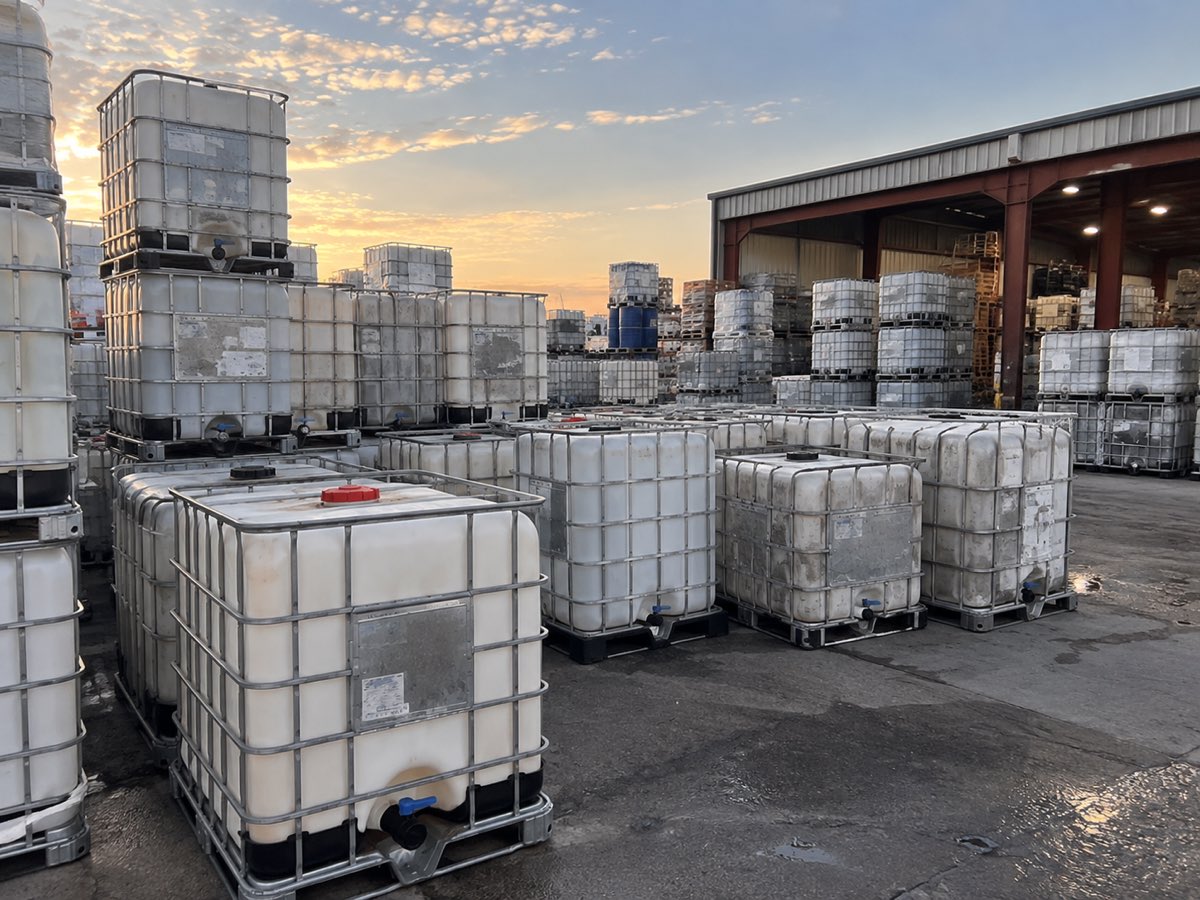
The containers were not broken. They had held surfactant, they were empty, and nobody in the building had a job description that included working out what to do with them. So they went on a truck, and the company paid for the truck, and at the other end a landfill charged by the ton for 115 pounds of perfectly serviceable HDPE inside 60 pounds of galvanised steel.
Seventeen years later that is still the core inefficiency we exist to exploit. It is not a technology problem and it never was. It is a coordination problem: the person holding the empty container and the person needing one are usually within a hundred miles of each other and have no mechanism to find out.
Everything we have built since — the wash lines, the rebottling line, the granulator, the UN reconditioner code, the thirty-eight partner yards — exists to make that coordination fast enough and trustworthy enough that buying used is the obvious decision rather than the virtuous one.
At a glance
- Founded
- 2009
- Headquarters
- Savannah, GA
- Ownership
- Family held, no outside capital
- Own yard
- 1 (Savannah)
- Certified partner yards
- 38
- States served
- 48
- Wash chemistries
- 3
- UN reconditioner code
- Held since 2023
- Telephone lines
- 0
Short answer
Timeline
Ten things that changed how we operate
Each of these was a capital decision that made buying used easier for somebody else. That is the only test we apply.
2009
One flatbed, one lane
Marcus Vreeland starts hauling empty totes out of a Garden City chemical blender who was paying to landfill them. The whole business is a 1998 flatbed, a pallet jack and a hand-written ledger.
2011
The first wash bay
A leased 4,000 sq ft bay off Abercorn Street gets a hot-water lance and a drain interceptor. Reconditioned totes start outselling as-is totes within four months.
2013
Food-grade segregation
A juice co-packer asks for documented prior contents. We build the affidavit process, physically separate the food line, and never mix the two streams again.
2015
Rebottling line
We stop scrapping good cages. New bottles arrive by the truckload, spent bottles go to the granulator, and the rebottled grade is born.
2017
Granulator and baler
Resin recovery goes in-house. For the first time, a tote that arrives at our gate has no path that ends in a landfill.
2019
Ten years, one million totes
The cumulative diversion counter crosses 1,000,000 units. We publish the methodology instead of just the number — and we have published it every year since.
2021
38 partner yards
Instead of building depots, we certify independent yards to our wash and grading standard. Freight miles per tote drop 41% against our 2019 baseline.
2023
UN re-certification
We earn our own reconditioner registration code and begin re-marking assemblies in-house, cutting a three-week bottleneck to four days.
2025
Diversion reporting
ESG teams start asking for audit-ready tonnage. We turn our internal ledger into a customer-facing certificate — same data, same methodology, now yours.
2026
Where we are now
1.48 million totes diverted, 48 states served, and a stubborn refusal to sell anyone a new tote when a reclaimed one will do the job.
How we actually operate
Six rules that are written down
Not values. Rules — the kind a trader can be corrected against, which is the only kind that changes behaviour.
Used before new, every time
A trader must exhaust reclaimed stock across our yard and all partner yards before quoting a new container. New gets quoted when a written specification requires it, and the rebottled alternative is quoted alongside.
Prior contents in writing, every grade
Including as-is. If prior contents cannot be established, the unit goes to the recovery stream rather than the sales floor. There is no "probably soap" category.
Grade never travels upward
No chemical tote becomes food grade. No rinsed unit gets called reconditioned because it looks clean. Downgrading is routine; upgrading does not exist.
Recommend down when it fits
If a cheaper grade does the job, say so in the quote. We lose revenue on this weekly and it is the single biggest reason customers come back.
Nothing landfills
Every unit has a documented disposition. Since 2017 none of those dispositions has been a landfill, and the weigh tickets are available to anyone who asks.
Publish the unflattering numbers
Our own 88 kg per unit reconditioning cost, our emissions breakdown, the 6% of intake that fails resale. A figure nobody can check is marketing.
Scale
Where seventeen years got us
- 1.5M
- Totes diverted
- 38
- Certified partner yards
- 48
- States served
- 7
- Average turns per bottle
Cumulative since 2009
Independent, audited to our wash and grading standard
Everywhere but Alaska and Hawaii
The number we are judged on internally
Why no phone number?
Quoting a used container needs five written facts: prior contents, quantity, grade, destination zip and timeline. On a phone call at least one of them routinely gets heard wrong, and the consequence is a trailer of totes that are not fit for the job. We tried it for eight months in 2010 and stopped. Every form on this site reaches a named trader, and we answer within one business day.
Contact details →Why partner yards instead of depots?
Because freight is 43% of our own carbon footprint and a large share of the price a customer pays. Building depots would have added capacity; certifying independent yards to our wash and grading standard shortened hauls instead. Freight miles per tote are down 41% against our 2019 baseline, and that shows up in both the invoice and the carbon figure.
Coverage & locations →More about us
Inside the Savannah Yard
The wash line, test bay and grading floor, walked through.
Industries We Serve
Eleven sectors and eleven definitions of clean.
Careers
Yard, logistics and trading roles in Savannah.
Coverage & Locations
One yard, 38 partner yards, 48 states.
Our Eco Mission
Why reuse beats recycling, with the arithmetic.
FAQ
34 answers about buying, selling and shipping totes.
By the numbers
What the company looks like in 2026
Published because a supplier who will not tell you their size is usually either very small or expects you to assume they are large.
| Measure | Figure | Notes |
|---|---|---|
| Founded | 2009 | One flatbed and a rented bay |
| People | 31 | All in Savannah; no remote sales team |
| Own facilities | 1 | Abercorn Street, Savannah, GA |
| Certified partner yards | 38 | Independent, unannounced annual audit |
| Yards decertified since 2021 | 2 | Published because zero would mean we are not auditing |
| States served | 48 | Not Alaska or Hawaii; the economics never work |
| Wash chemistries | 3 | Caustic, hot water (segregated), solvent |
| UN reconditioner code | Held since 2023 | Re-marking in four days rather than three weeks |
| Units through the yard, cumulative | 1.48 million | Since 2009 |
| Units landfilled since 2017 | 0 | Verifiable against weigh tickets |
| Outside investors | 0 | Family held; no institutional capital |
| Telephone lines | 0 | By policy, since 2010 |
How we are structured
Five desks, and who you actually reach
Small enough that every enquiry lands with a named person. This is who does what, so you know where your message goes.
| Desk | People | Handles | Reaches you within |
|---|---|---|---|
| Trading | 6 | Quotes, sourcing, grade recommendations, buying empties | 1 business day |
| Reconditioning | 11 | Wash lines, cage shop, test bay, UN marking | Scheduled work |
| Logistics | 4 | Freight booking, collection runs, dunnage, site constraints | 1 business day |
| Materials and reporting | 3 | Granulator, baler, regrind sales, diversion certificates | 5 business days for a certificate |
| Fabrication | 5 | Cut-downs, manifolds, jackets, skids, custom builds | 2 days to scope |
| Administration | 2 | Accounts, scheduling, records retention | Same day |
Short answer
- Every form on this site reaches the trading desk
- Nobody here is paid commission on grade upselling
- The same trader handles your quote and your follow-up
- Records are retained for the life of the container plus two years
From the Yard Journal
Longer pieces from the people who run the wash line, the test bay and the trading desk.
14 July 2022 · 7 min
The disposal invoice that started a company
A Garden City blender was paying $19,400 a year to bury containers that were not broken. Here is the arithmetic that turned that line item into a business.
Marcus Vreeland · Founder
Read11 June 2026 · 5 min
Seventeen years in, what we got wrong
Five decisions I would make differently, including the one that cost us four years and the one I still cannot decide about.
Marcus Vreeland · Founder
Read5 March 2026 · 4 min
Tote pooling maths for a blender shipping to forty customers
A worked example with real numbers: when a managed pool beats owning containers, and the two conditions under which it does not.
Dale Ferreira · Logistics lead
Read
Next move
Come and see it. 10305 Abercorn St, Savannah, GA 31406.
Walk the grading floor during open hours, including Saturday mornings. Nobody should buy two hundred containers from a stock photograph, and we would much rather you came and looked.