Totes & parts · P-03
Reconditioned
IBC totes.
Short answer
- Three wash chemistries: caustic, hot water, solvent
- 30-day leak warranty on our process
- UN re-marking available in-house, 4-day turnaround
- Net 126 kg CO₂e avoided versus a new equivalent
Price reconditioned units
The line
Five stations, in this order, every unit
Nothing here is exotic. What makes a reconditioned tote good or bad is whether the supplier actually does all five steps, or quietly skips the two that cost money.
- 01
Drain and manifest
Residue drained and manifested
- 02
Wash
Caustic or hot-water wash depending on prior contents
- 03
Rinse and inspect
Triple rinse, interior camera inspection
- 04
Cage and base
Cage straightened, welds checked, pallet repaired or swapped
- 05
Test and label
Leakproofness test at 3 psi, then re-labelled
Short answer
- Caustic: alkaline-compatible residues, ag chemicals, soaps
- Hot water: sugars, starches, food residues, glycols
- Solvent: resins, adhesives, coatings, inks
- Rejected: unidentifiable residue, un-manifested hazmat
What you receive
The paperwork is half the product
| Document | What it states | Why it matters |
|---|---|---|
| Prior-contents disclosure | Material, filler and date of last fill | Compatibility and grade traceability |
| Wash certificate | Chemistry, temperature, cycle time, operator | Audit evidence for your incoming inspection |
| Leakproofness test record | 3 psi air test, pass/fail, date | Required at the 2.5-year periodic for hazmat |
| Cage inspection note | Weld check, straightening performed, base type | Stacking and handling safety |
| UN re-marking (when applicable) | Marking string, test date, our reconditioner code | Legality of regulated shipments |
Why this grade
Reconditioned is the environmental optimum
Not the cheapest, not the cleanest — the best trade between the two, and by a distance the lowest-carbon container that still comes with a test certificate.
126 kg CO₂e avoided per unit
Building a new composite IBC costs about 214 kg CO₂e. Reconditioning one costs us about 88. The difference is the whole argument, and the coefficients are published.
7.4 turns per bottle, average
A bottle that is washed rather than replaced goes round seven times before it is granulated. Rebottling resets that counter to one.
Tested, not just rinsed
The 3 psi leakproofness test is the line between reconditioned and rinsed grade. It costs us a few minutes per unit and it catches the failures that otherwise arrive at your dock.
Chemistry matched to residue
Three lines, chosen by prior contents. It is why our reconditioned units do not carry odour into your product.
In-house re-certification
We hold our own reconditioner registration code. UN re-marking takes four days after test rather than the three weeks a third-party queue used to cost.
Cage and base refurbished too
Straightened uprights, checked welds, repaired or swapped bases. A washed bottle in a bent cage is not a reconditioned tote, whatever the invoice says.
Questions
Reconditioned questions
What does reconditioned actually mean?
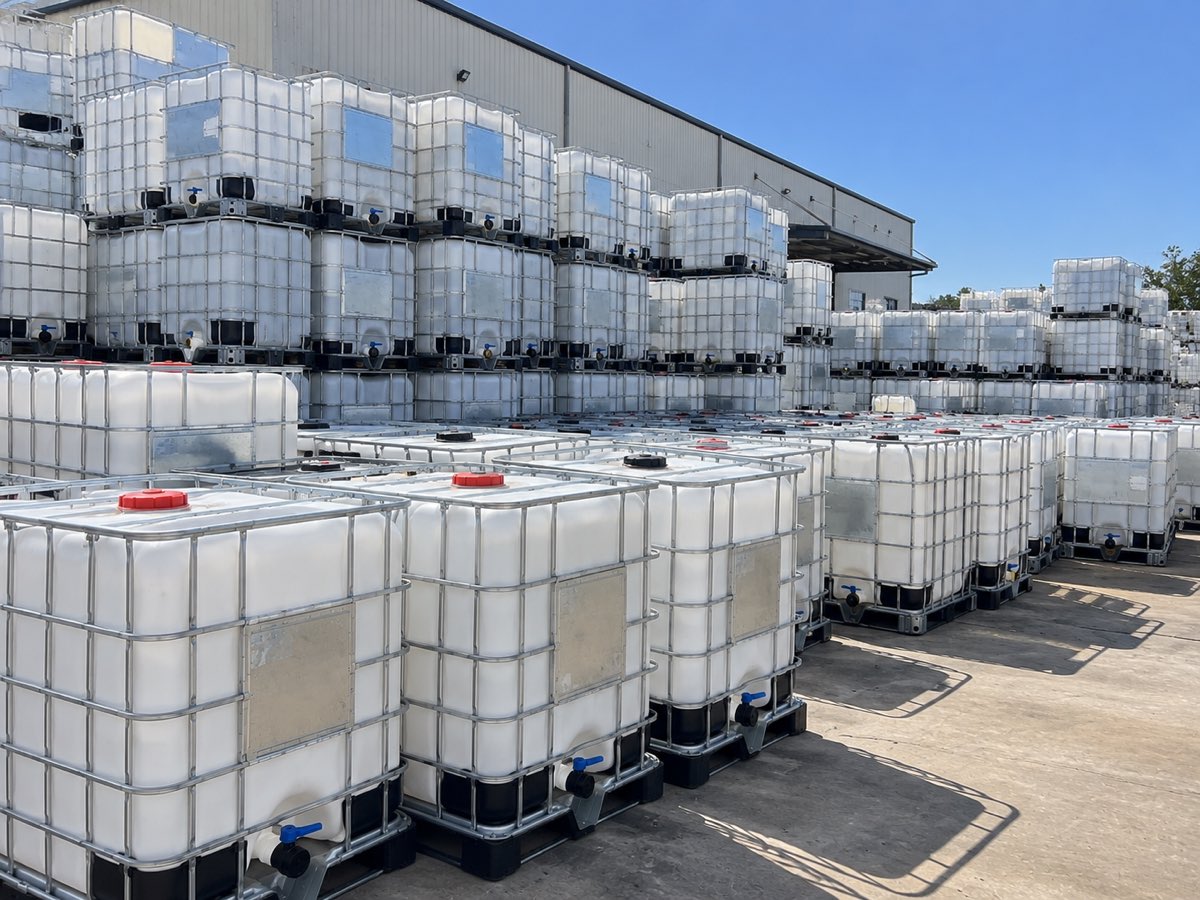
That the original bottle was washed on a pressurised line with chemistry chosen for its prior contents, triple-rinsed, camera-inspected inside, leak-tested at 3 psi, and reunited with a straightened cage, a sound base and a new gasket. You receive a wash certificate and a test record. It does not mean the bottle is new, and it does not upgrade the container to food grade.
How do I know which wash chemistry was used?
It is on the wash certificate, along with the prior contents it was chosen for. Caustic for alkaline-compatible residues and most ag chemicals, hot water for sugars, starches and food residues, solvent for resins, adhesives and coatings. Washing a resin tote with caustic is how you produce a container that still smells six months later.
Is a reconditioned tote good enough for hazmat?
If the UN marking on the plate is valid and inside its service window, and the packing group authorisation covers your material, yes. Composite IBCs carry a five-year life from the moulding date with a leakproofness retest at 2.5 years. We re-test and re-mark in-house under our own reconditioner code.
Can a reconditioned tote be used for drinking water?
Only if it is food grade — which is a separate grade with a documented food-contact-only history. A reconditioned ex-chemical tote cannot be promoted to potable duty by any wash process. Grade does not travel upward.
What is the warranty on a reconditioned tote?
Thirty days against leaks arising from our process. That covers seating, gaskets, valve assembly and anything the test should have caught. It does not cover chemical incompatibility with your product, which is a specification decision we cannot make for you.
Keep reading
Rebottled Totes
When you need a virgin bottle but not a new tote.
Reconditioning Service
We will wash totes you already own — toll washing.
Grades Explained
All six grades, side by side, with price bands.
UN/DOT Certification
Leakproofness, hydrostatic and stack testing.
Our Carbon Math
Where the 126 kg figure comes from, coefficient by coefficient.
How to Clean a Tote
If you would rather do it yourself.
The paperwork
What a wash certificate actually records
A reconditioned unit without a wash certificate is a rinsed unit with a better invoice. This is every field on ours, and why each one is there.
| Field | Example | Why it is recorded |
|---|---|---|
| Serial / asset reference | RE-4417 | Ties the document to one physical container |
| Prior contents | Anionic surfactant blend | Determines chemistry and compatibility for you |
| Wash line | Caustic | Evidence the chemistry matched the residue class |
| Concentration | 3.2% NaOH | Auditable process parameter |
| Temperature | 78 °C | Below this, alkaline washes under-perform |
| Cycle time | 12 min | Dwell is as important as temperature |
| Rinse count | 3 | Each at ≥10% of container volume |
| Final rinse conductivity | 142 µS/cm | Objective verification rather than a visual check |
| Interior inspection | Camera, pass | Residue rings, haze, crazing, bottom-radius cracks |
| 48-hour odour hold | Pass | The only check that catches permeation |
| Leakproofness test | 3 psi, pass | The dividing line between reconditioned and rinsed |
| New gasket compound | EPDM | So you know what is in contact with your product |
| Operator and date | Initials, 2026-03-11 | Accountability and traceability |
When you are comparing suppliers, ask to see a blank certificate. The fields a supplier records tell you exactly which steps their process contains — and the two that are most often missing are the final-rinse verification and the 48-hour hold.
Ordering
Lead times, quantities and what moves them
Reconditioned is our highest-volume grade, so stock is usually available. These are the realistic timings once a quote is accepted.
| Order | From stock | Washed to order | What drives the difference |
|---|---|---|---|
| 1 – 4 units, yard collection | Same or next day | 5 – 9 days | Stock on the grading floor |
| 5 – 20 units, delivered | 3 – 7 days | 7 – 12 days | Lane and LTL schedule |
| 21 – 42 units, full trailer | 4 – 8 days | 9 – 14 days | Trailer booking plus wash queue |
| Uniform fleet, one batch | 7 – 12 days | 10 – 16 days | Matching cages and bases takes sorting |
| With UN re-marking | +4 business days | +4 business days | Test bay, then plate |
| With base swap to plastic | No change | No change | Done during disassembly |
| With specified gasket compound | No change | No change | Fitted at the last station |
Ask for a uniform fleet
If the containers are going into racking or a repeatable handling routine, specify “uniform fleet” and we pull from a single reconditioning batch. Matching cage manufacturers, base types and valve positions makes rack layouts and lift routines consistent. It adds a few days and $8 – $15 a unit.
Ask for serial photographs
On any order above about twenty units we will photograph a representative sample: interior through the lid with a flash, the specification plate, one upright-to-rail weld and the base fixings. Four images per serial answers most of the seventeen-point checklist without a visit.
From the Yard Journal
Longer pieces from the people who run the wash line, the test bay and the trading desk.
2 September 2022 · 6 min
Why your tote still smells after we washed it
Permeation is not a cleaning failure. It is a material property of HDPE, and understanding it explains most of the grading rules in this industry.
Priya Raghunathan · Head of reconditioning
Read18 December 2025 · 4 min
Our grading floor is deliberately boring
Six labelled bays, one decision per unit, no judgement calls allowed at the end of a shift. Interesting processes produce inconsistent grades.
Priya Raghunathan · Head of reconditioning
Read26 October 2023 · 5 min
Our first failed partner yard audit
We decertified a yard in 2021. They were not cutting corners on purpose — they were running one wash chemistry, and that is enough.
Marcus Vreeland · Founder
Read
Next move
Tell us the prior contents and the new contents.
Those two facts decide whether reconditioned is the right grade or whether you need rebottled, food grade, or simply a cheaper rinsed unit. We would rather sell you the cheap one that works.