Services · S-05
Freight &
logistics.
Short answer
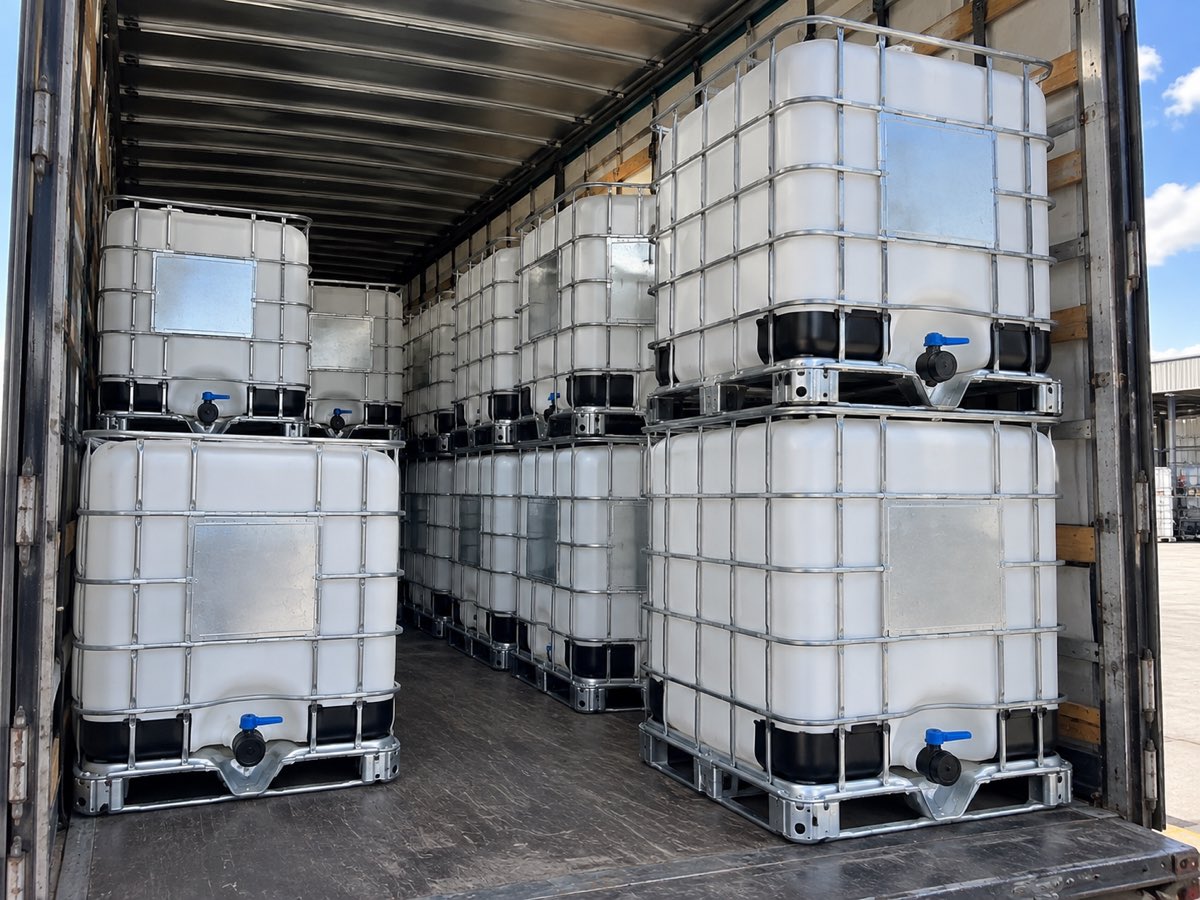
- Nesting cages: 42 per van. Non-nesting: 36.
- Lift-gate, dock and ground-drop options
- Reusable corner board and straps, never stretch-wrap
- We haul for customers who bought elsewhere too
Quote a move
Loading maths
A 53-foot van, two-wide
48 inches long by 40 wide means a tote can go lengthwise two-across in a 100-inch interior with room to strap. That single geometric fact governs every freight quote in this industry.
Plan view · 53-ft van · 21 positions × 2 wide = 42 nested empties
| Equipment | Empty, nesting | Empty, non-nesting | Filled (weight limited) |
|---|---|---|---|
| 53-ft dry van | 42 units | 36 units | 18 × 275 gal ≈ 44,000 lb |
| 48-ft dry van | 38 units | 32 units | 18 × 275 gal |
| 28-ft pup trailer | 20 units | 18 units | 9 × 275 gal |
| 48-ft flatbed | 40 units (tarped) | 34 units | 18 × 275 gal |
| Hotshot / 40-ft gooseneck | 24 units | 20 units | 14 × 275 gal |
| Box truck, 26-ft | 14 units | 12 units | 8 × 275 gal |
Filled 330s hit the weight limit faster: 15 units of water-density product is about 43,500 lb. Full maths, including stacking and strapping patterns, on the freight and palletizing guide.
Service options
Four ways a tote arrives
LTL, dock-to-dock
Cheapest for 1 – 8 units. Needs a dock and a forklift at both ends. Transit is 3 – 7 days depending on lane and how many terminals the shipment passes through.
LTL with lift-gate
For sites with no dock. The unit comes to ground level, but you still need a pallet jack and a hard surface — a lift-gate onto gravel is how pallets get dropped.
Flatbed with ground drop
9 – 30 units to outdoor sites. Forklift or telehandler offload, or a ground drop if you have the equipment. Standard for construction and agricultural destinations.
Full trailer
30 – 42 nested empties. Lowest cost per unit by a wide margin, and the only sensible option above 30 units. Needs dock access and a crew for about ninety minutes.
Short answer
- Dock height, or no dock at all
- Forklift capacity and whether it is available on the day
- Gate width, turning radius, overhead clearance
- Surface: asphalt, concrete, gravel or dirt
Dunnage
Reusable corner board, not film
A small decision that compounds. Stretch-wrapping 42 totes uses roughly 11 lb of film that becomes waste at your dock the same afternoon.
We secure loads with reusable corner board and ratchet straps. The dunnage comes back on the next inbound run on the same lane, gets inspected, and goes out again. A set lasts about forty round trips before the corner board delaminates, at which point it is cardboard and gets recycled.
Over a year of moderate volume that is a few hundred pounds of film your receiving team does not have to cut off, bale and pay to remove. It is not a headline number. It is the kind of decision that makes the headline numbers real.
If your facility genuinely requires shrink-wrapped pallets — some automated receiving lines do — say so at order time and we will quote it rather than arguing about it on the dock.
Questions
Freight questions
How many empty totes fit on a trailer?
42 nested empties in a 53-foot van if the cages nest and you load two-wide, three-high. Non-nesting units drop that to 36. Filled, you are weight-limited long before you are space-limited: 18 filled 275s is about 44,000 lb.
Do you ship to all 50 states?
48. We are not set up for Alaska or Hawaii container freight, and the economics almost never work for a used tote.
Can you deliver without a dock?
Yes — lift-gate LTL for small orders, flatbed with ground-drop for larger ones. Tell us the site constraints up front; a reconsignment because the truck cannot unload is the most expensive mistake in this business.
How do you protect totes in transit?
Reusable corner board and strap dunnage, not stretch-wrap. It comes back on the next inbound and it does not become film waste at your dock.
Lane coverage
Transit expectations from Savannah and the partner network
Stock is sourced from whichever yard is closest to you, so these are network transit times rather than times from our gate.
| Destination region | LTL | Partial | Full trailer | Notes |
|---|---|---|---|---|
| Coastal GA, SC, northern FL | 1 – 2 days | 1 – 2 days | 1 day | Short-haul lanes from our own yard |
| Southeast interior | 2 – 3 days | 2 – 3 days | 1 – 2 days | Densest part of the network |
| Gulf and South Central | 3 – 4 days | 2 – 4 days | 2 days | Strong reconditioned supply locally |
| Midwest | 3 – 5 days | 3 – 4 days | 2 – 3 days | Best food-grade sourcing |
| Northeast and Mid-Atlantic | 3 – 5 days | 3 – 4 days | 2 – 3 days | Tight docks; lift-gate common |
| Mountain and Southwest | 4 – 6 days | 4 – 5 days | 3 – 4 days | Full trailers make far more sense |
| West Coast | 4 – 6 days | 4 – 6 days | 3 – 5 days | Plan lead time; regional supply is tight |
Transit is from despatch, not from order. Add the lead time for the grade you have ordered — which for stock reconditioned units is a day or two and for food grade in August can be several weeks.
Accessorials
The charges that appear after the base rate
Published because freight quotes in this industry have a reputation for growing after acceptance, and almost all of that growth is these seven lines.
| Charge | Typical cost | Triggered by | How to avoid it |
|---|---|---|---|
| Lift-gate | $45 – $85 per shipment | No dock at the delivery point | Tell us at order time; it is cheaper booked than added |
| Residential or limited access | $55 – $120 | Farms, sites without commercial docks | Describe the site honestly up front |
| Inside delivery | $75 – $160 | Driver moving units past the dock edge | Have a forklift or pallet jack ready |
| Detention | $75 – $150 per hour after free time | Truck waiting beyond 1 – 2 hours | Have someone available in the window |
| Reconsignment / redelivery | $180 – $320 plus storage | Failed first delivery attempt | Answer the four site questions |
| Reweigh or reclass | $35 – $90 | Declared weight or class wrong | Give us the product density |
| Appointment scheduling | $25 – $60 | Receiver requires a booked slot | Tell us if your site requires one |
Short answer
- Lift-gate costs less booked than added on the day
- Detention starts after 1 – 2 hours of free time
- A reconsignment is the most expensive line on this table
- Four site facts at order time prevent most of these
From the Yard Journal
Longer pieces from the people who run the wash line, the test bay and the trading desk.
30 July 2024 · 4 min
The three questions that prevent a reconsignment
A truck that arrives and cannot unload costs several hundred dollars plus a redelivery. In four years, every single one traced back to the same three facts.
Dale Ferreira · Logistics lead
Read20 June 2023 · 5 min
Shrink wrap is a receiving-dock tax
Eleven pounds of film per trailer, cut off and binned the same afternoon. We switched to reusable corner board in 2019 and it cost us more. Here is the accounting.
Dale Ferreira · Logistics lead
Read4 April 2024 · 4 min
The economics of a ten-unit order
Ten units is the most common order size we quote and the most frequently mispriced by the buyer. The lever is not the grade.
Nina Caldwell · Trading desk
Read
Next move
Give us origin, destination and unit count.
Plus whether there is a dock at each end. That is enough for a firm freight number — and often enough for us to suggest a quantity change that drops your cost per unit by a fifth.