Totes & parts · P-01
275 gallon
IBC totes.
Short answer
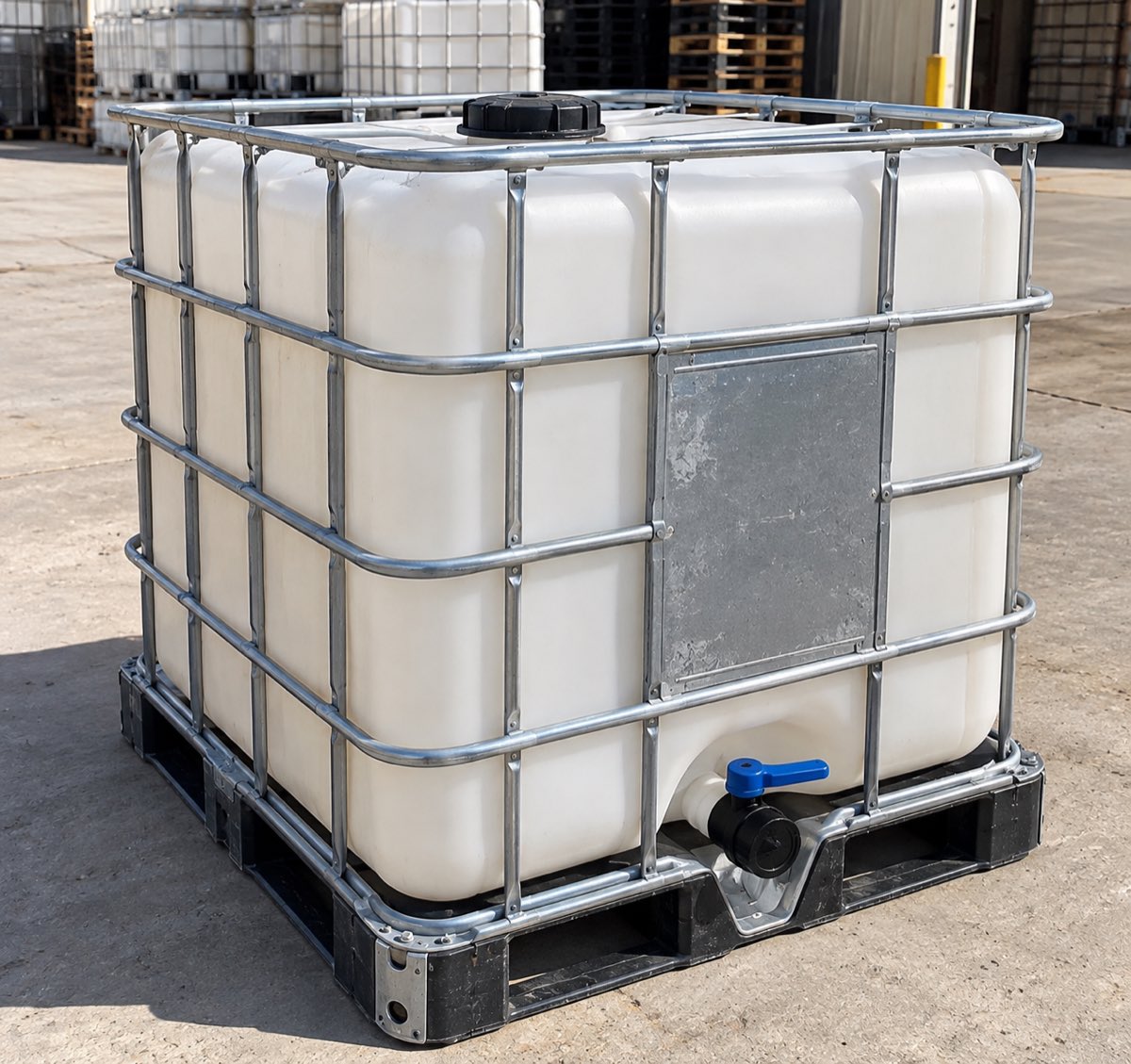
- Fits two-wide in a 53-ft trailer, clears a 7-ft dock door
- Typically rated 3-high stacked when filled
- DN50 (2 in) butterfly valve, 6 in fill lid as standard
- Steel, plastic or composite base on request
Price 275-gallon units
Specification
The numbers you will be asked for
Printed here because you should not have to email a supplier to find out whether a container fits through your door.
| Attribute | Imperial | Metric |
|---|---|---|
| Nominal capacity | 275 US gallons | 1,040 litres |
| Actual brim capacity | ~287 US gallons | ~1,086 litres |
| External dimensions | 48 × 40 × 46 in | 1,200 × 1,000 × 1,168 mm |
| Pallet footprint | 48 × 40 in (GMA) | 1,200 × 1,000 mm |
| Tare weight, steel base | 132 lb | 60 kg |
| Tare weight, plastic base | 125 lb | 57 kg |
| Gross, water filled | 2,427 lb | 1,101 kg |
| Volume occupied | 36.8 ft³ | 1.04 m³ |
| Fill opening | 6 in screw lid | 150 mm |
| Discharge | DN50 / 2 in butterfly | S60×6 buttress outlet |
| Bottle material | HDPE, ~115 lb | HDPE, ~52 kg |
| Cage material | Hot-dip galvanised tube, ~60 lb | ~27 kg |
| Typical UN marking | UN31HA1/Y | Packing groups II & III |
| Stacking, filled | 3 high (assembly-specific) | — |
| Service life, hazmat | 5 years from moulding date | Retest at 2.5 years |
$55 – $110
As-is / unwashed
Residue disclosed, structurally sound, washed by you or cut up.
$120 – $225
Reconditioned
Washed, pressure-tested, straightened cage, new gasket. Our volume grade.
$185 – $340
Food grade
FDA-compliant bottle with a prior-contents affidavit and plastic base.
Ex-yard Savannah, quantity 4+. Add freight. Full pricing guide →
Anatomy
Six parts, six failure modes
On a 275 the bottle almost always ages out before the cage does. That single fact is why rebottling exists and why we will pay you for a tote with a cracked bottle.
Part 02 of 06
HDPE inner bottle
Blow-moulded high-density polyethylene, roughly 52 kg of resin on a 275-gallon unit. This is the part that ages: UV crazing, chemical stress cracking and permeation all live here. When the bottle is spent, the cage usually has years left — which is exactly why rebottling exists.
What it is good at
Where the 275 is the right answer
It is the default for a reason: it is the largest liquid container that one person with a pallet jack can still move around a normal building.
Bulk dilution and dosing
Big enough to be worth plumbing, small enough that a mistake costs 275 gallons rather than 5,000. The standard unit for admixtures, surfactants and nutrient dosing.
Rainwater and irrigation
A 275-gallon food-grade unit on a block stand gives you gravity feed to a drip line. One inch of rain on a 500 sq ft roof is roughly 300 gallons — one tote per storm.
One-way product shipment
Replaces five 55-gallon drums with one handling unit and one connection. The labour saving is usually larger than the container saving.
Wash-water and reclaim
Car washes, equipment yards and food plants use rinsed-grade 275s as reclaim buffers. Grade requirements are low; replacement supply matters more.
Emergency water staging
Municipalities stage food-grade 275s for potable distribution. Sanitise before use; a tote that has been dry for a season is not clean.
Fabrication stock
Cut-down tubs, planter walls, dunnage, hydroponic beds. The as-is grade exists largely for people who are going to take an angle grinder to it anyway.
Where it is the wrong answer
Three times we talk people out of a 275
Dense product on a weak floor
At SG 1.4 or above a filled 275 passes 3,300 lb. If you are on a mezzanine, an older lift or a suspended slab, a 120-gallon half-height is the safer unit even though the price per gallon is worse.
Low ceilings or small doorways
Below about 52 inches of clear height you cannot handle a 275 on a pallet jack. Measure the doorway, not the room.
Small batch, frequent changeover
If you change product weekly, five drums you can dedicate beat one tote you have to wash. Cross-contamination costs more than drums do.
275 vs 330
Same floor space, 20% more liquid
| 275 gal | 330 gal | |
|---|---|---|
| Height | 46 in | 53 in |
| Footprint | 48 × 40 in | 48 × 40 in |
| Tare | 132 lb | 148 lb |
| Gross (water) | 2,427 lb | 2,902 lb |
| Stack, filled | 3 high | 2 – 3 high |
| Cost per gallon stored | Baseline | 8 – 12% better |
The 330 is better value per gallon stored, right up until the moment the extra seven inches collides with a trailer roof, a rack beam or a two-high storage limit.
See the 330Questions
275-gallon questions we answer weekly
What are the exact dimensions of a 275 gallon IBC tote?
48 inches long × 40 inches wide × 46 inches tall, on a 48 × 40 inch GMA pallet footprint. That is 1,200 × 1,000 × 1,168 mm. Empty weight runs 125 – 140 lb depending on the base type, and a water fill brings the gross to roughly 2,440 lb.
How much does a 275 gallon tote weigh when full?
Water at specific gravity 1.0 weighs 8.345 lb per gallon, so 275 gallons is 2,295 lb of product plus 132 lb of tare — about 2,427 lb. A product at SG 1.4, such as 50% caustic, pushes the gross past 3,340 lb, which exceeds the safe working load of some older forklifts and most mezzanine floors.
Will a 275 gallon tote fit through a standard door?
At 46 inches tall on the pallet it clears a 7-foot dock door comfortably and will pass through a 48-inch-wide opening if you take it in lengthwise on a pallet jack. It will not fit through a standard 36-inch interior door — that is the most common delivery problem we see.
How many 275 gallon totes fit on a truck?
Filled, you are weight-limited: 18 units is about 44,000 lb, which is a legal full load. Empty and nesting, up to 42 units fit a 53-foot van loaded two-wide and three-high. Non-nesting cages drop that to 36.
Can I stack 275 gallon totes?
Most composite 275s are rated three high when filled, but the rating belongs to the specific assembly and is printed on the specification plate — not to the size. Never stack a unit with a repaired pallet, and never stack on uneven ground.
Keep reading
Reconditioned Totes
The grade most 275 buyers actually want.
Food-Grade Totes
If anything edible or potable goes in it.
Dimensions & Weights
Every size compared, with fill weights by density.
Valves & Fittings
What the DN50 outlet threads into.
How to Clean a Tote
Six-step field procedure, and what not to attempt.
Rainwater Harvesting
Build a 275-gallon catchment that lasts.
What arrives
Exactly what ships with a 275, by grade
The most common post-delivery surprise in this trade is a component somebody assumed was included. This is the full inclusion list, grade by grade.
| Component | As-is | Rinsed | Reconditioned | Rebottled | Food grade |
|---|---|---|---|---|---|
| HDPE bottle | Original | Original | Original, washed | New | Original, hot-water washed |
| Galvanised cage | As received | As received | Straightened, weld-checked | Shot-blasted, straightened | Straightened, weld-checked |
| Pallet base | As received | As received | Repaired or swapped | Repaired or swapped | Plastic or composite |
| Discharge valve | Original, may be worn | Original | New or refurbished | New | New |
| Valve gasket | Original | Original | New, compound specified | New | New, food-grade EPDM |
| 6 in lid | Original | Original | Original or new | New | New, solid unless vented requested |
| Lid gasket | Original | Original | New | New | New, food-grade |
| Outlet dust cap | If present | If present | Included | Included | Included |
| Prior-contents disclosure | Yes | Yes | Yes | N/A (new bottle) | Affidavit reference |
| Wash certificate | No | No | Yes | Yes | Yes |
| 3 psi test record | No | No | Yes | Yes | Yes |
| UN re-marking | No | No | On request | Where it qualifies | On request |
Anything in that table can be specified differently at order time. The two worth asking about are the gasket compound, which should match your product rather than our default, and the base type, which should match your floor. Both cost very little and both are expensive to change later.
Compatibility
What HDPE will and will not hold
A 275-gallon composite tote is a polyethylene vessel in a steel frame. The frame is rarely the constraint; the polymer and the gasket are. This is the short version of the compatibility conversation.
| Product class | HDPE bottle | Gasket | Notes |
|---|---|---|---|
| Water, brines, aqueous salts | Excellent | EPDM | The default case. No special handling. |
| Caustics (NaOH, KOH) to 50% | Excellent | EPDM | Watch gross weight — SG 1.53 at 50% |
| Dilute mineral acids | Good | EPDM or Viton | Check concentration; some oxidisers attack |
| Concentrated oxidising acids | Poor | PTFE-envelope | Usually needs a dedicated or stainless vessel |
| Surfactants, detergents, soaps | Excellent | EPDM | Our highest-volume category |
| Glycols, coolants | Excellent | EPDM | Washes out cleanly; good reuse candidate |
| Vegetable and mineral oils | Good | Nitrile or Viton | Slow permeation; expect a dedicated unit |
| Aromatic and chlorinated solvents | Poor | Viton | Permeates. Dedicated service only. |
| Fragrances, essential oils, terpenes | Poor | Viton | Permanent permeation. Never regradable. |
| Liquid fertilisers, ag nutrients | Excellent | EPDM | SG up to 1.4 — check lift capacity |
| Food syrups, concentrates, oils | Excellent | Food EPDM or silicone | Food-grade donor required |
Short answer
- Send the product name and we will specify the gasket
- Permeating products need a dedicated unit, not a better wash
- Above SG 1.4, check your forklift before your container
- Oxidising acids usually mean stainless, not composite
From the Yard Journal
Longer pieces from the people who run the wash line, the test bay and the trading desk.
21 May 2026 · 4 min
What a crushed cage tells you about the bottle inside
Counterintuitively, the worse the cage looks, the better the odds on the bottle. We pulled three years of intake records to check.
Priya Raghunathan · Head of reconditioning
Read6 December 2022 · 6 min
Reading a cage weld: a field guide to the joint that kills totes
The upright-to-rail joint decides whether a cage is rebottled or baled. Here is what we look at, in what order, and why a bowed upright is fine but a kinked one is not.
Priya Raghunathan · Head of reconditioning
Read18 December 2025 · 4 min
Our grading floor is deliberately boring
Six labelled bays, one decision per unit, no judgement calls allowed at the end of a shift. Interesting processes produce inconsistent grades.
Priya Raghunathan · Head of reconditioning
Read
Next move
How many 275s, and what is going in them?
Give us the liquid, the unit count and your zip code and you will have grades, serial-specific photos and a landed freight number the same business day.